EU PPWR and Electric Fan Packaging: What Importers, Brands and Distributors Need to Know

Packaging is often treated as the final step in an electric fan project. Once the fan design, motor, performance, safety testing and artwork have been approved, the remaining question is usually how to protect the product at the lowest possible cost. The European Union’s new Packaging and Packaging Waste Regulation changes that approach. Under Regulation […]

Factory Audit China: How to Evaluate an Electric Fan Manufacturer

A polished supplier profile can hide weak controls, unstable output, and unsafe parts. Finding these problems after shipment turns a low price into an expensive mistake. To evaluate an electric fan manufacturer in China, audit its legal identity, production capacity, quality controls, component sourcing, testing ability, certifications, and packaging system. Compare documents with real factory […]

Powder Coating or Electroplating for Coastal Fan Guards?

A fan guard may look strong when it leaves the factory. Near the sea, however, salt can quickly attack every weld, edge, and scratch. For coastal fan guards, outdoor-grade powder coating with proper surface treatment usually lasts longer than standard decorative electroplating. For long-term use near the sea, the best choice is often a duplex […]

Drum Fan vs Pedestal Fan vs Blower Fan: Which One Should You Choose?

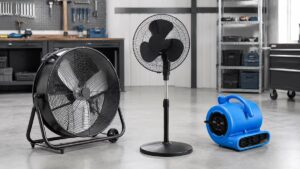
Comparison of a drum fan, pedestal fan, and blower fan in an industrial workshop

Choosing the right fan is not simply a matter of finding the model with the highest airflow rating. A drum fan, pedestal fan, and blower fan are designed for different jobs. One may be ideal for cooling people in a workshop, while another is better for moving air through a large warehouse or drying a […]

Are Cheap Lead Wires Ruining Your Fans?

A detailed educational infographic comparison image with a large headline at the top asking: "ARE CHEAP LEAD Wires RUINING YOUR FANS?" Below the headline is an illustration of a disassembled fan motor with visible copper coils and three distinct types of cut-away lead wires fanning out. From left to right: a red insulated wire stripped to reveal multiple strands of pure copper, with a label reading: "100% PURE COPPER LEAD WIRE (GRADE A)"; a blue insulated wire showing a single thick silver-colored metal core with a thin outer copper layer, labeled: "COPPER-CLAD ALUMINUM (CCA) LEAD WIRE (GRADE B)"; and a gray insulated wire with a single thick silver-colored metal core, labeled: "PURE ALUMINUM LEAD WIRE (GRADE C)". Two red arrows point to a charred and damaged section of the CCA and aluminum wires, with a red text box pointing to the area reading: "MOTOR BURNOUT". The background shows a blurred professional laboratory or workshop setting with equipment and a fully assembled fan, reinforcing the context. The overall image visually contrasts Grade A pure copper wiring with Grade B (CCA) and Grade C (aluminum) wiring, suggesting that using cheaper alternatives leads to motor failure and burnout.

Busy season ended, but returns are piling up. Customers complain about dead motors and smoke. The cause? It is often just a cheap wire inside. Yes, cheap lead wires are the hidden reason why many fan motors burn out or stop working. To save a few cents, some factories use poor materials like aluminum. These […]

Ask For A Quick Quote