Sleeve vs. Ball Bearing: Which Suits Your OEM Budget?

A detailed photograph comparing two types of bearings on a desk, designed for an OEM (Original Equipment Manufacturer) decision-making context. In the center-left, a cylindrical brass-colored sleeve bearing is labeled 'SLEEVE (Oil-lubricated)' with short stacks of coins in front. To its right, an open silver ball bearing showing internal steel balls is labeled 'BALL (rolling)' with significantly taller stacks of coins in front, indicating a higher initial cost. Below the physical objects are clear bar charts. The chart for 'Sleeve' shows a shorter bar for 'INITIAL COST' and a bar reaching about 50 for 'LIFESPAN'. The chart for 'Ball' shows a longer bar for 'INITIAL COST' and a bar reaching 100 for 'LIFESPAN'. In the background, a person holds a tablet with a complex chart titled 'OEM BUDGET CHOICE' and 'ROI' (Return on Investment). A whiteboard with mechanical blueprints and computer monitors with other charts are visible, reinforcing an engineering office environment. The image visually guides a manufacturer on the cost versus long-term value trade-offs.

For an OEM electric fan project, the bearing inside the motor may look like a minor component. In reality, it can influence motor noise, service life, mounting flexibility, warranty claims, and the final product price. Sleeve bearings generally offer a lower purchase cost and quiet initial operation. Ball bearings usually cost more but can provide […]

Cold vs. Hot Rolled Silicon Steel: Which Boosts Motor Efficiency?

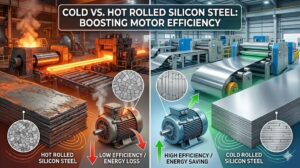
A high-resolution comparative infographic and photographic image showing how hot-rolled and cold-rolled silicon steel affect electric motor efficiency. The top central title states: "COLD VS. HOT ROLLED SILICON STEEL: BOOSTING MOTOR EFFICIENCY". The image is vertically split. The left section, with warm orange and red tones representing heat and energy loss, is dedicated to "HOT ROLLED SILICON STEEL". At the top, a rugged steel mill is producing glowing red-hot metal with large rolling machines and heat. Below, a close-up shows a stack of rough-textured, dark hot-rolled steel sheets. A magnified inset circle displays a disorganized, random grain structure. Further below, a schematic inset shows turbulent, inefficient magnetic flux lines. At the bottom center, an old, overheating motor is pictured with a downward-pointing red arrow and the text "LOW EFFICIENCY / ENERGY LOSS". The right section, with cool blue and green tones representing controlled temperature and efficiency, is dedicated to "COLD ROLLED SILICON STEEL". At the top, a clean, modern facility uses advanced automated machinery for cold-rolling silver metal sheets. Below, a close-up shows a stack of smooth, reflective, light-colored cold-rolled steel sheets. A magnified inset circle displays a perfectly aligned, neat, oriented grain structure (取向硅钢). Further below, a schematic inset shows smooth, efficient magnetic flux lines. At the bottom center, a clean, modern motor runs smoothly with an upward-pointing green arrow and the text "HIGH EFFICIENCY / ENERGY SAVING".

High energy bills and poor motor performance can hurt your business. Are you using the wrong materials? The steel inside your motor makes a huge difference. Cold-rolled silicon steel boosts motor efficiency much better than hot-rolled steel. The cold rolling process aligns the steel grains perfectly. This lowers core energy loss and increases magnetic strength. […]

71x16mm vs. 66x14mm: Which Stator Size Lasts Longer?

A detailed product comparison photograph on a brushed metal workbench. At the top, bold white and yellow text poses the question: "WHICH STATOR LASTS LONGER? 71x16mm vs. 66x14mm FAN MOTOR COMPARISON." Arrows point from the text to two unmounted AC fan motor stators below, shown side-by-side. On the left, the stator labeled "66x14mm" is noticeably shorter and has a smaller circumference. It features a ring of thin copper wire windings that are flatter and more open. On the right, the stator labeled "71x16mm" is significantly taller and has a larger diameter, constructed with more steel laminations and features thicker, more voluminous, and much denser copper wire windings, suggesting more power and durability. The visual difference in size and copper wire amount is distinct.

Fans break down fast. A dead fan means hot rooms and lost money. The fix is inside the motor. You must check the stator size. The 71x16mm stator lasts much longer than the 66x14mm stator. The bigger 71x16mm size has more metal. This drops the heat, adds more power, and stops vibrations. These factors stop […]

Why Do Cheap Fan Motors Overheat After 4 Hours?

A detailed close-up photograph of a small electric fan actively smoking and overheating on a cluttered electronics repair workbench. The metal motor housing is melted and charred, revealing glowing orange-red coils inside a burnt hole. White smoke is billowing upwards from the damaged area. A digital temperature probe is inserted into the motor casing, with the thermometer displaying a dangerous "TEMP: 138.5°C". The background shows a variety of tools, wires, and electronic components.

Is your new fan too hot to touch? You buy a cheap fan, and it smells like burning plastic. It is scary and dangerous. Let us fix this. Cheap fan motors overheat after 4 hours because they use thin aluminum wires instead of pure copper. They also have bad bearings and lack heat safety parts. […]

Copper vs CCA: How to Test Motor Quality?

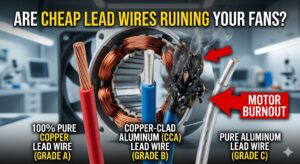
A split-screen infographic comparing two industrial electric motors, titled "COPPER vs CCA: HOW TO TEST MOTOR QUALITY" at the top in large white text against a blurred workshop background. On the left, an open motor with reddish-brown coils is labeled "PURE COPPER". A digital multimeter reads "0.2 Ω" and a digital scale shows "1.2 kg", with text "HEAVIER WEIGHT, LOW RESISTANCE" below. On the right, an identical open motor labeled "CCA (FAKE COPPER)" shows windings with silver-white metal exposed beneath the outer copper coating where insulation has been peeled back. A piece of stripped wire with a silver end lies in the foreground with an arrow from "SCRAPING A CORE" pointing to the motor. A digital scale reads "0.4 kg" and a digital multimeter reads "0.6 Ω", with text "LIGHTER WEIGHT, HIGH RESISTANCE" below. Both sides feature other lab equipment and toolboards in an industrial workshop setting. A scraping tool lies on the bench in the center foreground.

Worried your new motor is fake? Fake copper causes burnouts and lost money. Let’s fix that. Here is how to test your motor and find the truth. You can test if a motor is pure copper or Copper Clad Aluminum (CCA) by checking its weight and electrical resistance. Pure copper is much heavier and has […]

High Return Rates Killing Your Profits? Fan Quality Guide

A detailed, photo-realistic infographic within an industrial quality control (QC) laboratory, illustrating comprehensive procedures and standards for electric fan manufacturing, titled at the top: "FAN QUALITY GUIDE: STOP RETURNS. MAXIMIZE PROFITS." On the left, a technician in a lab coat, safety glasses, and gloves examines an opened fan motor with a digital multimeter. To his right, a graphic comparison contrasts 'PURE COPPER COIL' and 'CCA (COPPER-CLAD ALUMINUM) COIL', listing their respective advantages and attributes. Below them, a blue text box details the "'microscope' audit of the" fan motor coils and wire, including steps to check resistance, copper assistance, and character-clad aluminu, not characteristics or within motom coils. Behind him, a row of electric fans undergoes various performance and durability tests, including an 'OSCILLATION ENDURANCE TEST' and a '2-HOUR TEMPERATURE RISE TEST', with a monitor displaying QC data charts. A prominent board on the right outlines the 'QUALITY MANAGEMENT SYSTEM (QMS) & AQL STANDARDS', listing metrics for '0.4 CRITICAL', '1.5 MAJOR', and '4.0 MINOR' defects. The overall scene conveys professional, scientific, and thorough industrial QC and manufacturing processes.

High return rates act like a leak in your bank account. You pay for shipping twice and lose your reputation. Stop the bleeding by mastering these essential quality control steps today. High fan return rates are caused by motor failure, noise, and shipping damage. To fix this, wholesalers must audit motor materials, run 2-hour temperature […]

Ask For A Quick Quote