...

Why Do Cheap Fan Motors Overheat After 4 Hours?

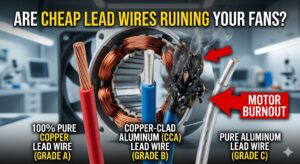
A detailed close-up photograph of a small electric fan actively smoking and overheating on a cluttered electronics repair workbench. The metal motor housing is melted and charred, revealing glowing orange-red coils inside a burnt hole. White smoke is billowing upwards from the damaged area. A digital temperature probe is inserted into the motor casing, with the thermometer displaying a dangerous "TEMP: 138.5°C". The background shows a variety of tools, wires, and electronic components.

Is your new fan too hot to touch? You buy a cheap fan, and it smells like burning plastic. It is scary and dangerous. Let us fix this. Cheap fan motors overheat after 4 hours because they use thin aluminum wires instead of pure copper. They also have bad bearings and lack heat safety parts. […]

Copper vs CCA: How to Test Motor Quality?

A split-screen infographic comparing two industrial electric motors, titled "COPPER vs CCA: HOW TO TEST MOTOR QUALITY" at the top in large white text against a blurred workshop background. On the left, an open motor with reddish-brown coils is labeled "PURE COPPER". A digital multimeter reads "0.2 Ω" and a digital scale shows "1.2 kg", with text "HEAVIER WEIGHT, LOW RESISTANCE" below. On the right, an identical open motor labeled "CCA (FAKE COPPER)" shows windings with silver-white metal exposed beneath the outer copper coating where insulation has been peeled back. A piece of stripped wire with a silver end lies in the foreground with an arrow from "SCRAPING A CORE" pointing to the motor. A digital scale reads "0.4 kg" and a digital multimeter reads "0.6 Ω", with text "LIGHTER WEIGHT, HIGH RESISTANCE" below. Both sides feature other lab equipment and toolboards in an industrial workshop setting. A scraping tool lies on the bench in the center foreground.

Worried your new motor is fake? Fake copper causes burnouts and lost money. Let’s fix that. Here is how to test your motor and find the truth. You can test if a motor is pure copper or Copper Clad Aluminum (CCA) by checking its weight and electrical resistance. Pure copper is much heavier and has […]

High Return Rates Killing Your Profits? Fan Quality Guide

A detailed, photo-realistic infographic within an industrial quality control (QC) laboratory, illustrating comprehensive procedures and standards for electric fan manufacturing, titled at the top: "FAN QUALITY GUIDE: STOP RETURNS. MAXIMIZE PROFITS." On the left, a technician in a lab coat, safety glasses, and gloves examines an opened fan motor with a digital multimeter. To his right, a graphic comparison contrasts 'PURE COPPER COIL' and 'CCA (COPPER-CLAD ALUMINUM) COIL', listing their respective advantages and attributes. Below them, a blue text box details the "'microscope' audit of the" fan motor coils and wire, including steps to check resistance, copper assistance, and character-clad aluminu, not characteristics or within motom coils. Behind him, a row of electric fans undergoes various performance and durability tests, including an 'OSCILLATION ENDURANCE TEST' and a '2-HOUR TEMPERATURE RISE TEST', with a monitor displaying QC data charts. A prominent board on the right outlines the 'QUALITY MANAGEMENT SYSTEM (QMS) & AQL STANDARDS', listing metrics for '0.4 CRITICAL', '1.5 MAJOR', and '4.0 MINOR' defects. The overall scene conveys professional, scientific, and thorough industrial QC and manufacturing processes.

High return rates act like a leak in your bank account. You pay for shipping twice and lose your reputation. Stop the bleeding by mastering these essential quality control steps today. High fan return rates are caused by motor failure, noise, and shipping damage. To fix this, wholesalers must audit motor materials, run 2-hour temperature […]

What Certifications Do You Need for Global Fan Markets?

A clean, modern commercial illustration of an electric floor fan, viewed from the front, centered before a globe marked "GLOBAL MARKET ACCESS." From the fan's hub, a network of arrows radiates outward to various certification marks, arranged in two columns. The left column shows "CE (EU)," "UL (North America)," "SASO (Middle East) [new logo]," and "SASO (Gulf) [older logo]." The right column shows "INMETRO (Brazil)," "DOE (US Energy)," "RoHS (EU Chemical)," and "REACH (EU Chemical)." The fan itself stands on a dark pedestal, set within a stylized outdoor customs checkpoint with blurred blue and red shipping containers, a gate with a green checkmark, and a truck. Above the globe, a prominent stamp reads "CUSTOMS PASSED APPROVED FOR GLOBAL TRADE." A main title bar across the top reads "GLOBAL FAN MARKET CERTIFICATIONS."

Exporting fans sounds easy until your cargo gets stuck at the border. One small mistake in your paperwork can lead to huge fines and lost sales that ruin your whole season. To sell fans globally, you must have specific safety and energy marks. The most common ones are CE for Europe, SASO for Saudi Arabia, […]

How Much Can CKD Save on Your Fan Shipping Costs?

An infographic comparing two shipping methods for electric stand fans: Completely Built Up (CBU) and Completely Knocked Down (CKD). At the top, a split view shows two open shipping containers. The left side, labeled "CBU: Completely Built Up," shows an disorganized container filled with fully assembled fans in retail boxes and loose, leaving much empty space. The right side, labeled "CKD: Completely Knocked Down," shows the same container densely and neatly stacked with standardized cardboard boxes labeled "CKD," maximizing space utilization.

High shipping costs and rising taxes are eating your fan business profits. Don’t let logistics ruin your margins. Switch to CKD shipping and save your business money starting today. Switching to CKD can reduce fan shipping costs by 50% to 70%. By shipping parts instead of assembled units, you fit 2.5 times more products in […]

Ask For A Quick Quote

Seraphinite AcceleratorOptimized by Seraphinite Accelerator
Turns on site high speed to be attractive for people and search engines.