Summer heat makes home life unbearable and sticky.
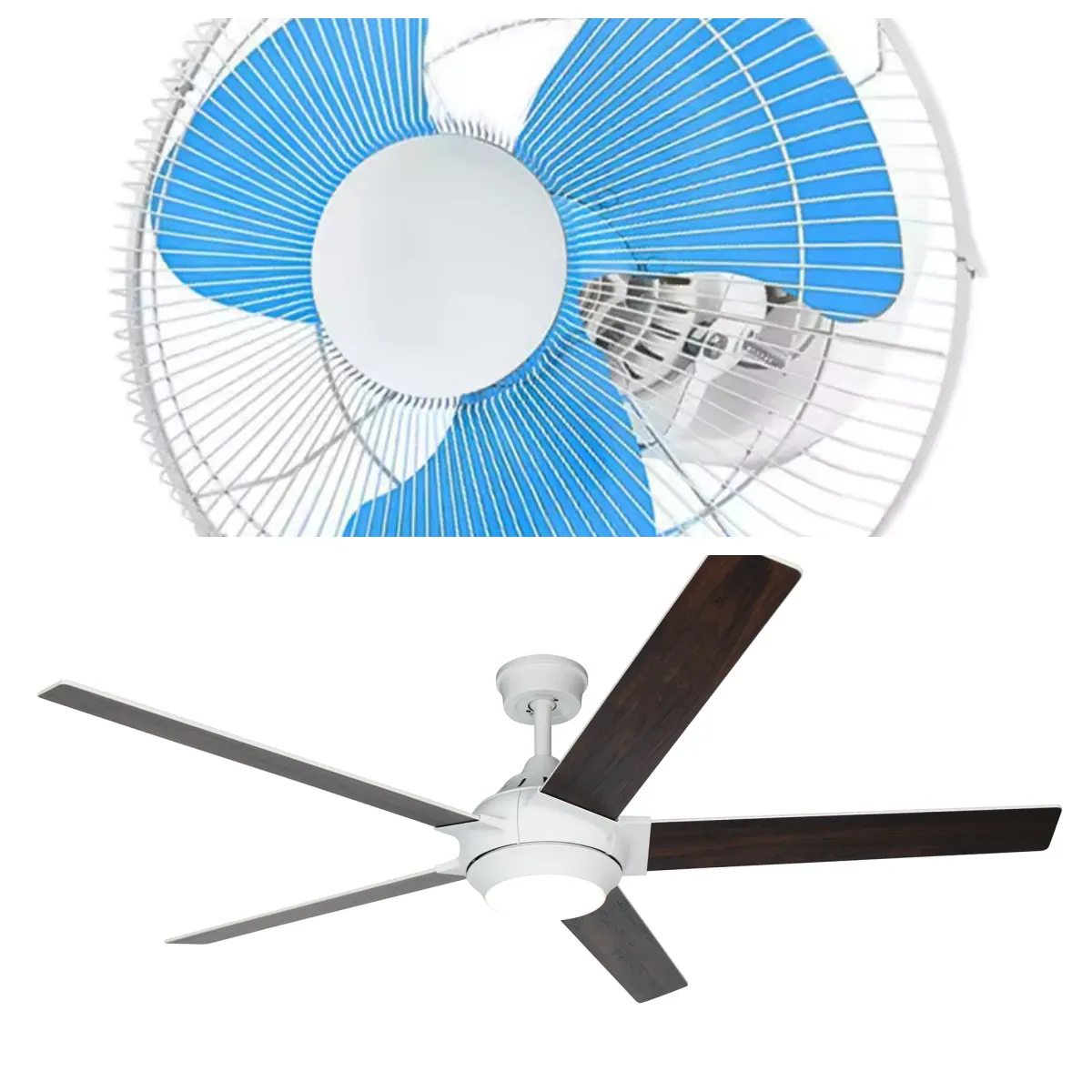
You need a cooling solution, but choosing between an orbit fan and a ceiling fan is often confusing and overwhelming.
The best choice depends on your specific needs.
Ceiling fans are powerful and cover large areas, making them great for living rooms.
Orbit fans are smaller, cheaper, and easier to install, which makes them perfect for small rooms and tight budgets.
Let’s look at the key differences so you can pick the right one for your home.
Fan Power
Weak airflow leaves you feeling hot and sticky.
You need a fan that actually cools the room down quickly without being too strong or annoying for your family.
Ceiling fans are generally more powerful, using large blades to cool big rooms up to 350 square feet.
Orbit fans have less power (40-50W) but use 360-degree oscillation to effectively cool smaller spaces with a gentle, intermittent breeze.
When we look closely at power, we see two very different approaches to moving air.
It is not just about which one blows harder, but how they deliver comfort to the people in the room.
The Difference in Airflow
Ceiling fans are the heavy lifters.
They usually have large blades and motors that run between 60W and 100W.
Because they are big, they push a massive column of air down.
This creates a constant breeze that touches every corner of a large room.
If you are in a spacious living room, a ceiling fan is efficient because it works evenly.
On the other hand, orbit fans are more subtle.
They typically run on 40W to 50W.
They do not blast air constantly in one spot.
Instead, they rotate 360 degrees.
This means the air “hits” you and then moves away, then comes back.
For a small room, this is excellent because a constant strong wind can be annoying.
The intermittent flow feels more natural in a tight space.
Key Power Differences:
- Ceiling Fans: Constant flow, high volume, better for large groups of people.
- Orbit Fans: Intermittent flow, targeted direction, better for individual comfort or small areas.
Ultimately, “more power” isn’t always better.
If you put a high-power ceiling fan in a tiny bedroom, it might feel like a storm.
If you put a low-power orbit fan in a huge hall, you won’t feel a thing.
You must match the power to the room size.
Space Usage
Cluttered rooms make relaxing hard and stressful.
You want a cooling solution that doesn’t eat up valuable floor space or get in the way of your daily life.
Orbit fans are the winners for saving space because they are small (16-18 inches) and mount on the wall.
Ceiling fans are larger (42-52 inches) but stay on the ceiling, so they don’t block your movement either.
Space is a huge concern, especially for families living in smaller apartments or houses.
We need to look at how these fans affect the “livability” of a room.
Physical Footprint vs. Visual Space
The orbit fan is the champion of compact design.
Most models are between 16 and 18 inches.
Because you mount them on the wall, they keep the floor completely clear.
This is crucial for small homes where every inch of floor matters.
You can walk under them and around them without ever touching them.
They are made of plastic and are light, so they don’t demand a heavy-duty wall structure.
Ceiling fans are physically much larger.
A standard size is 42 to 52 inches.
However, because they are on the ceiling, they also keep the floor clear.
So, technically, both fans save floor space.
But here is the difference: Visual Weight.
- Ceiling Fans: They dominate the center of the room. In a room with low ceilings, a big fan can make the space feel cramped or “heavy.”
- Orbit Fans: They are tucked away in a corner or on a side wall. They are less noticeable.
If you have very limited space, the orbit fan is less intrusive.
It does its job without becoming the focal point of the room.
Ceiling fans are great, but in a tiny room, they might feel like they are looming over you.
Safety
Worried parents always put safety first.
You don’t want a heavy appliance falling or hurting your children while they play inside your home.
Both fans are safe when installed correctly.
Ceiling fans hang high out of reach, and orbit fans use protective cages.
New regulations require extra safety wires, making accidents very rare for both types.
Safety is not just about the fan not falling down; it is also about interaction.
How likely is it that someone will get hurt by the blades?
Accessibility and Structure
Both fans have a major safety advantage: height.
- Ceiling fans must be installed at least 3 meters from the floor.
- Orbit fans are also mounted high on walls.
This height makes it almost impossible for children to touch the blades while playing.
An adult would need a ladder or a chair to reach them.
This eliminates the risk of accidental finger injuries, which is a common worry with pedestal or floor fans.
Construction and Falling Risks
Modern regulations (CE/CB requirements) have made these fans safer than ever.
Since 2019, many standards require a second suspension system.
This is a safety wire that catches the fan if the main mount fails.
Comparing Safety Features:
| Feature | Orbit Fan | Ceiling Fan |
| Material Weight | Light (Plastic/Aluminum) | Heavy (Wood/Metal) |
| Blade Protection | Mesh Casing (Cage) | Exposed Blades |
| Mounting | Wall Screws | Ceiling Bracket |
| Risk Level | Very Low | Very Low |
The orbit fan has a slight edge just because it is lighter.
If a plastic fan falls, it does less damage than a heavy wooden one.
Also, orbit fans have a cage around the blades.
Even if the front cover comes loose (which is rare because of screws), the risk is low.
However, strictly speaking, both are incredibly safe options for families with kids or dependents.
Function and Features
Basic cooling isn’t always enough for modern homes.
You might want lights, timers, or remote controls to make your life a little bit easier and more comfortable.
Ceiling fans offer the most technology, often including LED lights, timers, and advanced remote controls.
Orbit fans are much simpler, usually offering only three speeds and manual adjustments, though some have basic remotes.
When we talk about function, we are talking about convenience.
How much does the device do for you?
The “All-in-One” Benefit
Ceiling fans are the clear winners here because they are often 2-in-1 appliances.
- Air Conditioner: They cool the room.
- Lighting: Most modern ceiling fans come with built-in LED lights.
This saves you from having to install a separate light fixture in the center of the room.
It simplifies the ceiling layout.
Furthermore, ceiling fans often come with features like:
- Timers: Set it to turn off after you fall asleep.
- Winter Mode: Some fans can reverse direction to push warm air down in winter.
- Smart Home Integration: Expensive models connect to Wi-Fi.
Simplicity of the Orbit Fan
Orbit fans are designed for one thing: blowing air.
They usually have three speeds:
- Soft
- Moderate
- Strong
You can usually lock the head so it blows in one spot, or let it orbit 360 degrees.
That is about it.
The only “tech” feature you might find is a simple remote control on some models.
For many people, this is actually a plus.
There are no complex electronics to break.
It is a simple machine for a simple task.
If you want a fan that acts as a central piece of technology and lighting, the ceiling fan is the only choice.
If you just want air movement without the bells and whistles, the orbit fan is sufficient.
Price
Budgets are tight for many families today.
You shouldn’t have to spend a fortune just to keep your family cool and comfortable during the summer.
Orbit fans are the best choice for saving money, often costing around $20.
Ceiling fans are more expensive, ranging from $40 to over $150, because they use costlier materials and complex features.
Price is often the deciding factor.
The difference in cost between these two fans is significant, not just in the initial purchase, but in what you get for your money.
Material Costs vs. Performance
Why is there such a gap?
- Orbit Fans ($20+): These are mostly made of plastic. The manufacturing process is simple. They are functional tools. You are paying for the motor and the plastic mold.
- Ceiling Fans ($40 – $150+): You are paying for design and materials. These fans often use treated wood, polished aluminum, or glass for light fixtures. They are meant to be part of the home’s decoration.
Is the Extra Cost Worth It?
This depends on your priorities.
If you buy a ceiling fan, you are buying a piece of furniture.
It adds value to the look of the room.
The higher price is justified by the aesthetics and the dual function (light + fan).
However, if we look strictly at “Cooling per Dollar,” the orbit fan wins easily.
For $20, you get significant temperature relief.
To get the same cooling effect from a ceiling fan, you spend three to five times as much.
Price Breakdown:
- Budget Option: Orbit Fan (Plastic, simple).
- Mid-Range: Basic Ceiling Fan (Metal, no light).
- Luxury: Designer Ceiling Fan (Wood, remote, LED).
For a humble family that prioritizes function over luxury, the orbit fan is the unbeatable value option.
Energy Bills
High electricity bills hurt your wallet every month.
You need an appliance that cools your home without causing a massive spike in your monthly expenses.
Orbit fans consume less energy, usually staying under 60 watts.
Ceiling fans are powerful but use more electricity, often up to 100 watts.
If keeping costs low is your goal, choose the orbit fan.
The purchase price is one thing, but the running cost is another.
Over a long, hot summer, these costs add up.
Wattage Comparison
We can look at the raw numbers to understand the efficiency.
- Orbit Fan: Generally 40W to 50W. Even at maximum speed, they rarely exceed 60W.
- Ceiling Fan: Generally 60W to 100W.
This means a ceiling fan can use nearly double the electricity of an orbit fan.
Even if you use the “low consumption” mode on a modern ceiling fan, it often still draws more power than an orbit fan on a medium setting.
Impact on Monthly Expenses
For families where every cent counts, this difference matters.
- Scenario: Running a fan for 10 hours a day.
- Orbit Fan: Uses roughly 0.5 kWh.
- Ceiling Fan: Uses roughly 1.0 kWh.
Over a month, the ceiling fan doubles the cost of ventilation.
If you have fans in multiple rooms (living room, kitchen, three bedrooms), this multiplier effect can make your electricity bill much higher.
Technology is great, but it requires power.
The orbit fan proves that sometimes simpler technology is better for the wallet.
It provides comfort without the “luxury tax” on your energy bill.
Installation
Complex wiring can be scary and dangerous.
You want a fan you can set up yourself without calling an expensive electrician or risking injury during the process.
Orbit fans are much easier to install, requiring just a few screws and a wall mount.
Ceiling fans are harder to set up because they need complex wiring for lights and motors, and the heavy blades must be balanced.
Installation is the final hurdle.
A cheap fan isn’t cheap if you have to pay a professional $100 to install it.
The Ceiling Fan Challenge
Installing a ceiling fan is a project.
- Weight: You need to ensure the ceiling box can support a heavy vibrating motor.
- Wiring: You are often dealing with multiple wires for the motor, the light, and the ground. This can be confusing for an average person.
- Balancing: The blades must be attached separately. If they aren’t perfect, the fan will wobble and make noise.
This often requires a professional electrician, especially for elderly users or those not comfortable with tools.
The Orbit Fan Simplicity
Orbit fans are essentially “Plug and Play,” but with a wall mount.
- Drill: You drill a couple of holes in the wall.
- Mount: You screw in the bracket.
- Hang: You place the fan on the bracket.
- Plug: You plug it into a standard outlet.
There is no messing with live wires in the ceiling.
The fan comes mostly assembled.
You might have to clip the front cage on, but that is easy.
Installation Comparison:
| Factor | Orbit Fan | Ceiling Fan |
| Time Required | 15 – 30 Minutes | 1 – 2 Hours |
| Difficulty | Easy (DIY) | High (Expert recommended) |
| Tools Needed | Drill, Screwdriver | Ladder, Wire strippers, Voltage tester, Drill |
For older users or those who want a quick fix without headaches, the orbit fan is the superior choice.
Conclusion
It is a tie.
Choose a ceiling fan for large rooms, style, and extra features.
Choose an orbit fan for small spaces, easy installation, and saving money on bills.