Is your new fan too hot to touch?
You buy a cheap fan, and it smells like burning plastic.
It is scary and dangerous.
Let us fix this.
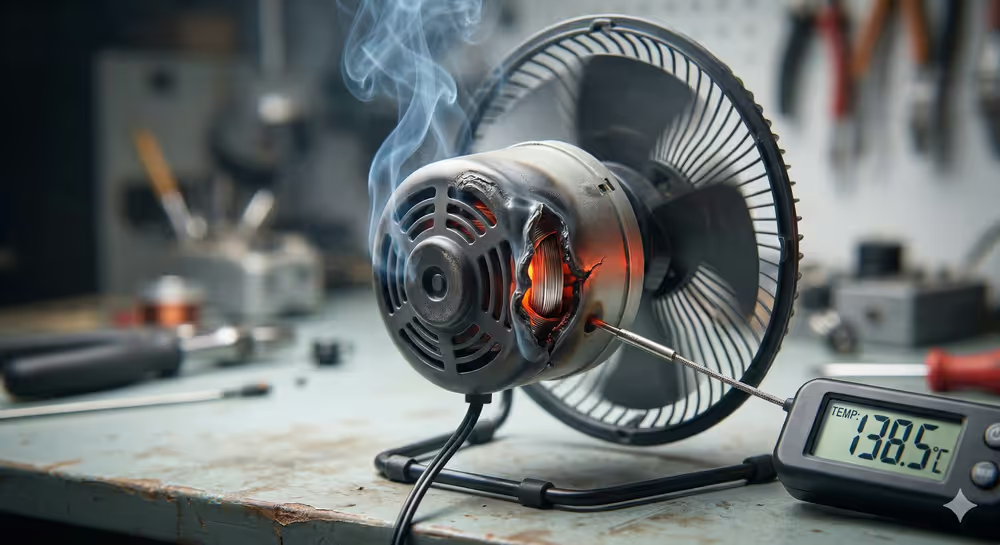
Cheap fan motors overheat after 4 hours because they use thin aluminum wires instead of pure copper. They also have bad bearings and lack heat safety parts. This causes high friction and trapped heat, which makes the motor burn out quickly and creates a real fire risk.
You do not want a fire in your house or a broken fan in the trash.
Keep reading to find out exactly what happens inside these bad motors when you leave them on.
Why Do Cheaper Fans Use Aluminum Wires Instead of Copper?
Worried about your fan wiring?
Different wires handle electricity and heat in different ways.
This changes how long the motor will last.
Let us look at the wire materials.
Cheaper fans use copper-clad aluminum (CCA) wires because aluminum costs much less than copper. But aluminum naturally gets warmer when electricity flows through it. If the motor lacks good cooling, this heat builds up and can damage the parts.
Copper is a great metal for fan wires.
It moves electricity very well and stays cool.
But pure copper costs a lot of money.
To save money, factories often use aluminum wires.
They coat the aluminum with a very thin layer of copper.
This is called CCA wire.
It looks like copper, but it acts like aluminum.
The Heat Difference with Aluminum
Electricity has a harder time passing through aluminum.
We call this higher resistance.
When resistance is high, more electricity turns into heat.
It is like rubbing your hands together to get warm.
Aluminum wires are not completely bad.
Many fans use them safely every day.
But aluminum motors need better cooling designs to stay safe.
Cheap fans usually skip these important cooling steps.
When you run a cheap aluminum fan, the heat gets trapped.
After four hours, the motor can become dangerously hot.
If the heat gets too bad, it melts the thin plastic skin around the wires.
When the bare wires touch each other, they short out.
During a standard temperature rise test, a fan runs for many hours.
Good copper motors stay well under the safe heat limit.
Cheap aluminum motors struggle to pass this test because their extra heat cannot escape.
Copper vs. Aluminum Comparison
Here is a simple look at the differences:
| Material | Cost | Heat Level | Safe Running Time | Lifespan |
| Pure Copper | High | Low | 24+ Hours | Many Years |
| Aluminum (CCA) | Low | Very High | Under 4 Hours | A few months |
How Factories Hide the Truth
You cannot easily see the wires inside a new fan.
Factories know this fact.
They use yellow or red paint on the aluminum wires.
This makes them look just like real copper.
But if you scrape the paint with a knife, you will see silver aluminum under it.
This trick fools many buyers.
If a fan is very cheap to buy, it almost certainly has aluminum wires inside.
This is the biggest reason why it gets too hot to touch.
How Do Bad Bearings Cause High Motor Temperatures?
Does your fan make a loud noise?
A noisy fan is a dying fan.
Bad parts rub together and make fire-causing heat.
Let us check the bearings.
Cheap fans use cheap sleeve bearings that run out of oil fast. Without oil, metal rubs hard against metal. This high friction creates a lot of heat. The motor must work much harder to turn the blades, causing it to overheat and fail quickly.
Bearings are the small, round parts that let the fan blades spin smoothly.
Good fans use ball bearings.
These have tiny metal balls inside them.
They roll very easily and last a very long time.
They do not get hot, even if you run the fan all day and all night.
Cheap fans use sleeve bearings.
A sleeve bearing is just a simple metal tube.
The metal fan shaft spins inside this tube.
It needs thick oil to stop the metal parts from scraping each other.
Why Sleeve Bearings Fail Fast
When a factory wants to save a few cents, they use bad sleeve bearings and very cheap oil.
Here is what happens over a few short months:
- Step 1: The cheap oil dries up because of the hot aluminum wires nearby.
- Step 2: Dust from your room gets inside the dry metal tube.
- Step 3: The metal shaft grinds hard against the dry, dirty metal tube.
- Step 4: The rubbing makes a lot of heat. We call this bad rubbing friction.
The Stuck Shaft Problem
When the friction gets too high, the motor gets stuck.
You might turn the fan on and hear a low humming sound, but the blades do not spin at all.
The electricity from your wall is still trying to turn the heavy motor.
Because the motor cannot move, all that raw electricity turns directly into heat.
This is a very dangerous time for the fan.
The motor gets hot enough to burn your skin.
Within a few short hours, the plastic parts inside the motor will melt into a sticky mess.
If the heat gets too high, it can start a room fire.
Good ball bearings stop this problem completely.
They cost more to buy, but they save the fan from burning up.
Why Are Cheap Silicon Steel Sheets a Big Danger?
Is your fan heavy or very light?
A light fan motor is missing important parts.
Missing parts mean poor power and dangerous heat.
Let us look inside.
Cheap motors use small, low-quality silicon steel sheets in the stator. This bad steel cannot handle magnetic fields well. It wastes a lot of electrical power. The wasted power turns into extreme heat, which bakes the motor from the inside out in just hours.
Inside every electric fan motor is a heavy metal part called the stator.
It is made of many thin sheets of metal stacked tightly together.
This metal is called silicon steel.
It is a very important part.
It takes the electricity from the wires and turns it into magnetic power.
This magnetic power is what spins the fan blades.
The Cost-Cutting Trick
Good quality silicon steel is expensive to buy.
So, cheap fan makers do two bad things to save their money:
- They use very low-quality steel instead of real, good silicon steel.
- They use fewer sheets of metal. This makes the stator very small, thin, and light.
Heat from Iron Loss
When you use bad steel, the motor gets confused.
It tries to make strong magnetic power, but the bad steel fights against it.
This fight inside the metal is called iron loss.
The energy that is lost in this fight does not just disappear into the air.
It turns directly into heat.
If the stator is too small and thin, it has less metal mass to absorb this heat.
It is like trying to boil water in a tiny cup instead of a big pot.
It boils over very fast.
Comparing Motor Weights
You can often guess the quality of a motor just by holding it in your hand.
| Stator Quality | Weight | Heat Build-Up Speed | Power Output |
| High Quality | Heavy | Slow | High (Moves lots of air) |
| Low Quality | Very Light | Extremely Fast | Low (Weak air flow) |
When you run a light, cheap motor for a full 4 hours, the bad steel gets so hot that it cooks the wires touching it.
This extreme heat makes the fan smell like burning chemicals.
Good fans have heavy, thick stators that manage heat much better.
Why Do Cheap Fans Skip Thermal Protection?
Are you afraid of sudden electrical fires?
Cheap fans have no safety net.
When they get too hot, nothing stops them from burning.
Let us check the safety parts.
Bad fan motors do not have a thermal fuse. A thermal fuse is a small safety switch. It cuts the power if the motor gets too hot. Without this part, a cheap motor will keep getting hotter until the wires melt and start a fire.
Every good fan has a secret guard hidden inside the motor.
It is called a thermal protector or a thermal fuse.
This is a very small electronic part.
It is tied closely to the copper wires inside the motor core.
How a Thermal Fuse Works
Think of a thermal fuse like a smart thermometer with a fast off switch.
When the motor is running normally, the fuse does nothing at all.
But if the motor gets stuck, or if it gets too hot (usually around 130 degrees Celsius), the fuse feels the dangerous heat.
It snaps open and breaks the electrical circuit.
The fan stops dead right there.
This stops the heat from growing and saves your house from a fire.
The Missing Safety Net
A thermal fuse is not expensive.
It costs maybe 10 or 20 cents for a factory to buy.
But in a very cheap factory, every single cent matters.
So, they simply leave the thermal fuse out of the motor.
They build the fan with no safety net at all.
The 4-Hour Death Trap
Let us look at what happens in a cheap fan without a fuse during a long 4-hour test:
- Hour 1: The aluminum wires get hot. The cheap sleeve bearings start to get dry.
- Hour 2: The motor struggles to spin. The bad steel core gets burning hot.
- Hour 3: The plastic parts inside the motor begin to melt. You start to smell burning plastic in the room.
- Hour 4: The wire skin completely melts away. The bare wires touch each other.
Because there is no thermal fuse to say stop, the power from the wall keeps pushing into the fan.
The wires spark, pop, and the motor burns out completely.
In a real testing lab, this fan fails instantly.
It is a very dangerous way for a factory to save 10 cents.
How Does Bad Plastic Shell Design Trap Motor Heat?
Does the back of your fan feel like a hot oven?
Bad covers trap heat inside.
A motor that cannot breathe will die fast.
Let us look at airflow.
Cheap fans use weak plastic shells with very few air holes. The motor needs moving air to stay cool. When the plastic shell has a bad design, the heat is trapped inside like an oven. This bakes the motor parts until they break.
Even a very good copper motor gets a little warm when it runs.
That is why it needs fresh room air.
The plastic cover over the back of the motor is not just for good looks.
It is a very important part of the whole cooling system.
The Need for Air Holes
A good fan motor cover has big, wide vents.
These holes let the hot air out and pull the cool room air in.
Some very good motors even have a small extra fan blade hidden inside.
This extra blade is just there to blow cool air over the hot motor itself.
The Cheap Plastic Problem
Cheap fan makers do not care about keeping the motor cool.
They only care about fast and cheap plastic molding.
- They make the plastic shell very small to save plastic material.
- They put very few holes in it, or they put the holes in the wrong places.
- They use thin, cheap plastic that gets soft and changes shape when it gets hot.
The Hot Oven Effect
When you put a cheap, hot aluminum motor inside a small, closed plastic box, you create a tiny oven.
The heat comes out of the hot wires, but it has nowhere to go.
It hits the inside of the solid plastic shell and bounces back into the motor.
| Shell Design | Airflow Level | Motor Temperature | Fire Risk Level |
| Large vents, smart design | Fast moving | Cool | Very Safe |
| Small shell, tiny holes | Blocked | Burning Hot | High Risk |
After four hours of running, this oven effect is too much for the fan.
The cheap plastic cover might even melt and stick right to the hot motor.
This blocks the air even more and guarantees the motor will die.
If you run a cheap fan on a hot summer day, this oven effect happens even faster.
A good fan motor must be able to breathe freely to pass the temperature rise test.
Conclusion
Cheap fans overheat fast because of bad aluminum wires, dry bearings, cheap steel, trapped heat, and no safety fuses.
Always buy heavy fans with real copper motors to stay safe.




![A clean, modern commercial illustration of an electric floor fan, viewed from the front, centered before a globe marked "GLOBAL MARKET ACCESS." From the fan's hub, a network of arrows radiates outward to various certification marks, arranged in two columns. The left column shows "CE (EU)," "UL (North America)," "SASO (Middle East) [new logo]," and "SASO (Gulf) [older logo]." The right column shows "INMETRO (Brazil)," "DOE (US Energy)," "RoHS (EU Chemical)," and "REACH (EU Chemical)." The fan itself stands on a dark pedestal, set within a stylized outdoor customs checkpoint with blurred blue and red shipping containers, a gate with a green checkmark, and a truck. Above the globe, a prominent stamp reads "CUSTOMS PASSED APPROVED FOR GLOBAL TRADE." A main title bar across the top reads "GLOBAL FAN MARKET CERTIFICATIONS."](https://sffanfactory.com/wp-content/uploads/2026/03/Global-Fan-Market-Certifications-and-Global-Market-Access-Graphic-300x164.jpg)