Skip to content
Busy season ended, but returns are piling up.
Customers complain about dead motors and smoke.
The cause?
It is often just a cheap wire inside.
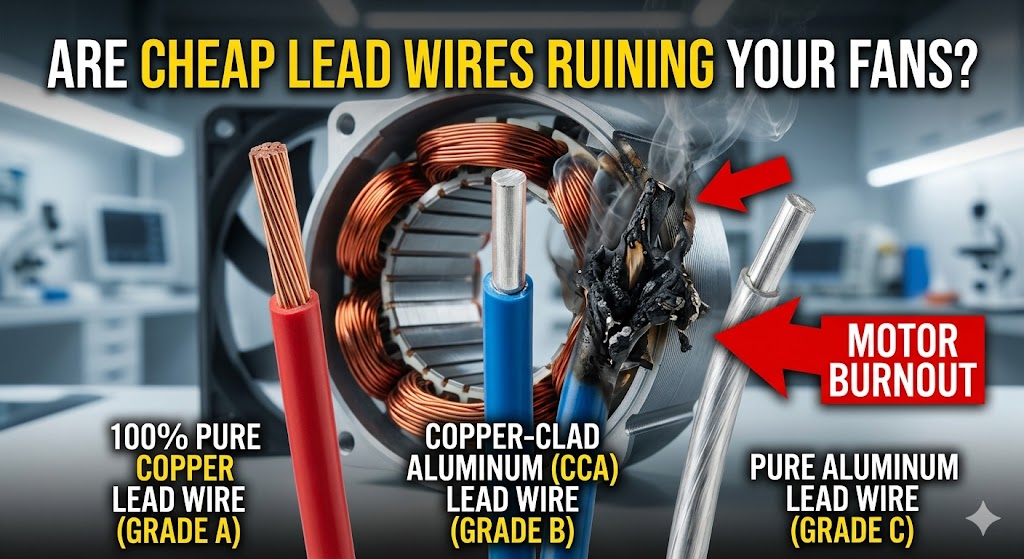
Yes, cheap lead wires are the hidden reason why many fan motors burn out or stop working.
To save a few cents, some factories use poor materials like aluminum.
These break easily under heat and vibration, destroying the whole fan.
If you want to stop paying for expensive returns and protect your good brand name, you must understand what happens inside your products.
Let us look closely at this tiny but vital part.
Keep reading to learn the hidden secrets of fan motors and how to make sure your factory is doing things right.
What is a Motor Lead Wire?
You never see this wire, but your fan cannot work without it.
If it fails, the whole unit dies.
Let us see what this vital part actually does.
A motor lead wire is the only bridge connecting the fragile enameled coils inside the motor to the outside power supply and speed switch.
It acts as the main blood vessel for the fan motor to get power.
Let us break down why this wire is so important to your product.
Think of it as a power highway.
To really get why fans fail, we need to look inside the motor.
The Core Job of the Wire
The inside of a fan motor is filled with many loops of very thin copper wire.
We call these enameled coils.
They are often as thin as human hair.
Because they are so thin and fragile, you cannot connect them directly to the thick power cord that goes into the wall.
You also cannot connect them directly to the heavy buttons on the fan stand.
You need a middleman.
The motor lead wire is this middleman.
It takes the strong power from the wall plug and the switch.
Then, it carries this power straight into those delicate thin coils safely.
Without this bridge, no power reaches the motor block.
The fan simply will not spin.
A Very Harsh Work Space
The inside of a motor is not a safe, clean, or calm place to work.
It is actually very rough.
When a user turns the fan on, a high rush of electrical power shoots through the lead wire.
This rushing power creates a lot of heat.
At the same time, the motor spins very fast to turn the fan blades.
This fast spinning causes heavy shaking and shaking.
But that is not all.
Most stand fans also swing from side to side.
We call this oscillation.
So, the wire inside is getting hot, it is shaking, and it is being bent back and forth.
The lead wire must handle high heat and constant physical stress for eight, ten, or even twenty hours straight.
Why Bad Wires Fail Fast
Because the work space inside the motor is so tough, the wire must be very strong.
If a factory uses a cheap or weak wire to save a little money, bad things happen very fast.
A weak wire cannot take the daily heat.
It gets too hot and begins to melt.
A weak wire also cannot handle the constant shaking.
Like bending a cheap paperclip back and forth, the metal gets tired and simply snaps.
When the wire breaks, the power stops.
The fan dies.
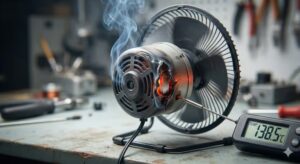
Worse, if the hot wire melts and touches another piece of metal, it creates a short circuit.
This burns the whole motor black.
A broken wire means a dead fan, and a dead fan means angry buyers asking for their money back.
You must make sure your factory uses strong wires that can survive this tough space.
The Truth About Materials: Pure Aluminum vs. CCA vs. Pure Copper
Factories use different metal grades to balance costs.
Choosing the wrong grade can affect your product and your buyers.
You must know these metals to choose the right specifications.
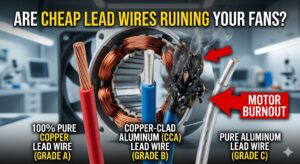
Fan motors use three main wire materials: pure aluminum, Copper-Clad Aluminum, and pure copper.
Aluminum and CCA represent Grade C and Grade B materials.
Pure copper is the Grade A choice because it carries power well and lasts much longer.
Let us look at the different material grades in the fan making business.
Some factories use different material grades to cut costs.
They might use a different grade of metal inside the lead wire.
You need to know the clear facts to protect your orders.
Pure Aluminum Wires: Grade C
This is the Grade C choice for your fan.
Aluminum is very cheap, but it provides Grade C power flow.
It acts like a very narrow water pipe trying to push a lot of water.
We say it has high electrical resistance.
Because of this, it loses a lot of energy and gets very, very hot when the fan runs.
Also, aluminum has Grade C durability.
It suffers from a problem called metal fatigue.
Think of bending a plastic spoon.
After a few bends, it snaps.
Aluminum is the same.
When the fan shakes, or when the box moves on a long sea trip in a container, aluminum wires easily snap at the joints.
The fan might not work before the customer even opens the box.
Copper-Clad Aluminum (CCA): Grade B
CCA wire is a Grade B alternative.
It stands for Copper-Clad Aluminum.
It is an aluminum wire with a very thin skin of copper.
How to identify it: It looks orange and shiny on the outside, just like real copper. Factories use it as a Grade B substitute.
The reality: It offers Grade B power flow, just a tiny bit better than pure aluminum, but it still gets too hot on high fan speeds. Also, because the inside is still aluminum, it has Grade B durability.
If you want to test for CCA, take a sharp knife and scrape the outside of the wire.
If you see white or silver metal under the orange skin, it is CCA.
It provides a Grade B lifespan for your fans.
Pure Copper Wires: Grade A
This is the Grade A standard.
Pure copper is a strong metal and provides Grade A power flow.
It acts like a huge, wide water pipe.
The power flows freely, so the wire stays cool.
Pure copper is also soft and bends well without breaking.
Even if the fan shakes for days and swings side to side, a pure copper wire holds tight.
It will not snap.
It lasts many times longer than aluminum.
Here is a simple table to show how they compare:
| Wire Material | Power Flow | Heat Control | Break Risk | Grade Level |
| Pure Aluminum | Grade C | Grade C | Grade C | Grade C |
| CCA (Copper-Clad Aluminum) | Grade B | Grade B | Grade B | Grade B |
| Pure Copper | Grade A | Grade A | Grade A | Grade A |
The Last Defense: Temperature and Fire Resistance of Insulation
A good metal wire is useless if the cover is cheap.
Bad covers melt easily, creating huge fire risks.
We must use heat-proof materials to stay safe.
The insulation skin protects the wire and stops electrical shorts.
Cheap wires use bad PVC that melts easily.
Good fans use high-heat, fire-proof insulation that handles 105 degrees Celsius or more, keeping the motor safe from fire.
You cannot just look at the metal inside.
The plastic skin wrapped around the wire is your very last defense against real danger.
We call this plastic skin the insulation.
Let us talk about why good insulation is a total must for your business.
The Hidden Danger of Cheap PVC
When bad factories use cheap aluminum or fake copper wire, they usually also use the cheapest plastic to cover it.
This cheap plastic is standard PVC.
Why is this bad?
When the weak aluminum wire gets hot from power, the cheap PVC plastic gets soft.
Soon, the plastic starts to melt away like butter in a hot pan.
If the plastic melts away, the bare metal wires are exposed.
When two bare wires touch each other, power finds a shortcut.
This creates a short circuit.
A short circuit makes a huge flash of heat and bright sparks.
Those sparks can easily start a fire inside the plastic fan body.
This is how house fires start.
The Right Choice: Fire-Proof Covers
A good, honest factory will never use cheap regular PVC on motor lead wires.
They use special covers made to handle extreme heat safely.
This better material is fire-proof.
We call it flame retardant material in the trade.
It is designed to sit safely in heat up to 105 degrees Celsius, and sometimes even higher.
Even if the wire inside gets warm, this strong skin will not soften, melt, or burn.
It locks the electrical power safely inside.
Staying Safe in Hot Climates
Think about where you sell your fans.
If you ship fans to hot places like the Middle East, Africa, or even during a hot summer in the USA, the heat problem gets worse.
The air in the room might be 40 degrees Celsius.
Then, the working motor adds another 60 degrees of heat.
Suddenly, the inside of the fan is at 100 degrees.
Cheap PVC melts at 80 degrees.
You need the best cover to survive these real-world tests.
| Feature | Regular PVC Cover | Flame Retardant Cover |
| Heat Limit | Low (Melts easily) | High (105°C and up) |
| Fire Risk | High | Very Low |
| Mostly Used By | Cheap, bad factories | Good, honest factories |
Always check the writing on the wire skin.
Look for numbers like “105°C” to know your product is safe.
Hidden Details: Welding and Fixing the Wires
Even great wires fail if poorly attached.
Cheap makers use messy tape that falls off, causing broken connections.
Let us look at how professionals lock wires down.
The way wires are welded and fixed inside the motor changes everything.
Cheap makers use simple black tape.
Good makers use heat-shrink tubes and nylon ties to lock wires down tight, stopping them from moving or breaking.
Even if you demand the best pure copper wire and the best fire-proof cover, lazy work can still ruin the fan.
The way the factory worker connects and ties the wire is a very big deal.
It is a hidden detail most buyers miss.
The Mess of Cheap Factories
Many fast, cheap factories do not care about doing things right.
They just want to work fast.
When they join the lead wire to the motor, they just twist the bare metals together.
Then, they wrap the joint in cheap black sticky tape.
This black electrical tape is terrible for hot fans.
Why?
Because tape uses glue.
When the motor gets warm during normal use, the glue on the tape gets wet, soft, and loses its stick.
The tape unrolls and falls off inside the motor.
Now, bare joints are exposed.
Also, lazy workers leave the wires loose inside the motor case.
When the fan shakes, the loose wires whip around.
They pull heavily on the joints until the twisted metals just break apart.
The Professional Standard Process
A high-quality maker follows strict rules for joining wires.
First, they do not just twist the metal; they weld it tightly with proper tools.
Then, instead of using bad sticky tape, they use a special part called a heat-shrink tube.
They slide this small plastic tube over the newly welded joint.
Then, they point a hot air gun at it.
The tube shrinks very fast and hugs the wire joint extremely tight.
It seals the joint forever.
It stops dust, stops water, and stops bare metals from touching.
Locking It Down Tightly
After sealing the joint perfectly, the worker must tie the wire down.
Professional workers use strong nylon cable ties.
They take the lead wire and tie it flat against the heavy main motor block.
This step is very important.
It keeps the wire totally still.
Because it is tied to the heavy block, it shakes with the motor, not against it.
No matter how much the fan moves, the wire does not pull on the fragile joints.
This simple step takes more time on the factory line, but it stops wires from breaking and keeps your fan running well for years.
Conclusion
Saving cents on cheap wires costs you dollars in huge returns.
Stop accepting dangerous aluminum parts.
Work with a trusted partner who uses 100% pure copper wires and safe, tight assembly.