

Sleeve vs. Ball Bearing: Which Suits Your OEM Budget?
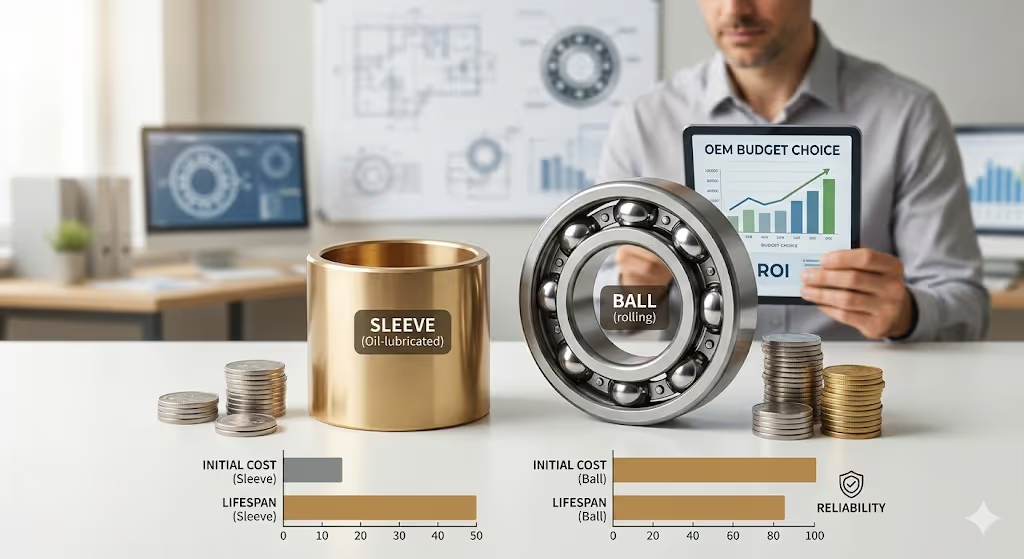
Table of Contents
For an OEM electric fan project, the bearing inside the motor may look like a minor component. In reality, it can influence motor noise, service life, mounting flexibility, warranty claims, and the final product price.
Sleeve bearings generally offer a lower purchase cost and quiet initial operation. Ball bearings usually cost more but can provide greater stability under continuous use, elevated temperatures, and demanding mounting conditions.
That does not mean every budget fan should use sleeve bearings or every premium fan should use ball bearings. The right choice depends on how the fan will actually be used and how much a product failure would cost your business.
This guide compares sleeve and ball bearing motors specifically for household and commercial electric fans, including table fans, pedestal fans, wall fans, air circulators, and ceiling fans.
What Is a Sleeve Bearing Fan Motor?
In a sleeve bearing motor, the rotor shaft rotates inside a cylindrical bushing. Many household fan motors use porous sintered metal bushings that retain lubricating oil. An oil reservoir or felt pad may also be added to support long-term lubrication.
The oil creates a film between the shaft and the bearing surface during operation, reducing direct metal-to-metal contact.
Sleeve bearing systems are popular in cost-sensitive electric fans because they have several advantages:
- Simple construction
- Low component cost
- Compact motor design
- Low initial mechanical noise
- Good performance in suitable horizontal-shaft applications
However, sleeve bearing performance depends heavily on manufacturing quality. Bushing material, oil content, shaft finish, bearing clearance, alignment, sealing, and motor temperature all affect the final service life.
Two motors labeled “sleeve bearing” can therefore deliver very different results.
What Is a Ball Bearing Fan Motor?
A ball bearing uses balls running between inner and outer races to support the motor shaft. Household fan motors may use one ball bearing, two ball bearings, or a hybrid structure combining a ball bearing with a sleeve bearing.
A double-ball-bearing motor generally provides better shaft support than a basic sleeve-bearing structure. It is also less dependent on the formation and retention of an oil film around the shaft.
Typical benefits include:
- Better suitability for extended operating hours
- Greater tolerance of different mounting orientations
- Improved support for combined radial and axial loads
- More stable performance at elevated temperatures
- Lower risk of lubrication loss in demanding applications
These benefits come with higher component and assembly costs. Ball bearings may also produce a slight rolling or tonal sound, particularly in a quiet room or at low fan speed.
As with sleeve bearings, quality matters. A poorly selected or incorrectly installed ball bearing can be noisy and unreliable. Bearing clearance, preload, grease, sealing, shaft fit, and bearing housing tolerances must all be controlled.
Sleeve vs. Ball Bearing at a Glance
| Factor | Sleeve Bearing | Ball Bearing |
|---|---|---|
| Initial purchase cost | Usually lower | Usually higher |
| Initial mechanical noise | Often lower | May have more audible rolling sound |
| Extended daily operation | Suitable when properly designed, but more application-dependent | Generally better suited |
| Mounting orientation | More sensitive to orientation and lubrication design | Generally more flexible |
| Elevated temperature | Lubricant loss can become a concern | Often more stable with suitable grease and seals |
| Axial-load capability | Depends strongly on the thrust system | Generally better when correctly specified |
| Manufacturing sensitivity | Sensitive to shaft finish, alignment, clearance, and oil system | Sensitive to fit, preload, grease, and housing accuracy |
| Typical application | Cost-sensitive, seasonal household fans | Commercial, long-life, high-duty, or long-warranty fans |
This table describes general tendencies, not guaranteed performance. A well-engineered sleeve-bearing motor can outperform a low-quality ball-bearing motor.
Which Bearing Is Quieter?
Sleeve bearings are often promoted as the quieter option. This can be true when the motor is new and operating at low or moderate speed. The oil film can produce very little mechanical sound, while ball bearings may create a faint rolling or high-frequency tone.
However, bearing type is only one part of electric fan noise.
Total fan noise can also come from:
- Blade turbulence
- Motor electromagnetic vibration
- Rotor imbalance
- Shaft misalignment
- Front and rear guard resonance
- Housing vibration
- Oscillation gears
- Loose fasteners
- Speed-control electronics
A quiet bearing cannot compensate for an unbalanced blade or a resonating guard.
Noise performance can also change as the motor ages. A sleeve-bearing motor that is quiet when new may become noisier if lubrication deteriorates or shaft clearance increases. A properly selected ball-bearing motor may maintain more consistent mechanical performance over extended use.
OEM buyers should therefore compare complete fan samples rather than bearing names alone. Noise should be measured both before and after an agreed aging test, at every available speed setting.
Which Bearing Lasts Longer?
Ball bearings are generally favored for long operating hours, but there is no universal number of hours that applies to every electric fan.
Online comparisons often claim that sleeve bearings last approximately 30,000 hours while ball bearings last 50,000 hours or more. Most of these figures come from small electronic cooling fans. They should not automatically be applied to household electric fan motors.
A pedestal fan motor and a computer cooling fan differ in:
- Shaft dimensions
- Rotational speed
- Rotor weight
- Blade load
- Motor temperature
- Mounting direction
- Lubrication system
- Operating cycle
- Exposure to dust and humidity
Published life figures are meaningful only when the test conditions are stated.
For ball bearings, an L10 rating means that 90% of a sufficiently large group of identical bearings are theoretically expected to reach or exceed the calculated life under specified load and operating conditions. It does not mean the complete electric fan will operate for that long.
The motor can still fail because of its winding, capacitor, thermal protector, lead wires, speed switch, electronic controller, or mechanical assembly.
For an OEM project, request life-test data that identifies:
- Ambient temperature
- Motor winding temperature or temperature rise
- Operating voltage and frequency
- Fan speed
- Mounting orientation
- Test duration
- Start-stop cycle
- Applied blade and shaft load
- Acceptable noise increase
- Failure definition
Without these conditions, an advertised lifetime is mainly a marketing number.
How Mounting Position Changes the Decision
Mounting orientation is especially important for electric fans.
Table, Pedestal, and Wall Fans
These products commonly use a horizontal motor shaft. A properly designed sleeve-bearing motor can be a practical and economical solution, especially when the fan is intended for seasonal household use.
The design must still control shaft alignment, oil retention, end play, and the thrust load created by the fan blade.
Ceiling Fans and Vertical-Shaft Products
A vertical shaft creates different lubrication and axial-load conditions. Ball bearings are often preferred, but the complete thrust-support system must still be examined.
Specifying “ball bearing” without identifying the number, position, and load rating of the bearings is not enough.
Air Circulators
High-velocity air circulators may operate at higher speed or for longer periods than conventional household fans. Premium sleeve systems, fluid-dynamic bearings, or double-ball-bearing motors may all be viable, depending on the required noise level and service life.
Commercial Fans
Fans used in shops, restaurants, workshops, offices, and industrial spaces may operate for 8 to 24 hours per day. For these applications, the additional cost of double-ball bearings is often easier to justify.
Do Ball Bearings Always Justify the Higher Price?
Not necessarily.
For a low-cost household fan used several hours per day during one season, a well-made sleeve-bearing motor may meet the required service life at a lower cost. Upgrading every product to double ball bearings could increase the retail price without delivering a benefit the target customer will notice.
The calculation changes when a fan has:
- Long daily operating hours
- A three-to-five-year warranty
- High motor temperatures
- Vertical or variable mounting positions
- Expensive international warranty service
- Commercial or semi-industrial users
- High retailer penalties for returns
- A premium durability claim
In these situations, a small increase in motor cost may reduce a much larger after-sales risk.
Calculate Total Cost, Not Just Motor Price
OEM buyers often compare quotations by looking only at the motor unit price. A more useful calculation is:
Expected cost per fan
= motor purchase cost
+ assembly and quality-control cost
+ expected warranty failure rate x cost per claim
+ return logistics and service cost
+ retailer penalties and brand risk
Consider a simplified example:
- A double-ball-bearing motor costs
US$0.80more. - Each motor-related warranty claim costs an average of
US$22. - The upgrade reduces the warranty failure rate by more than approximately
3.6 percentage points.
In that case, the higher-cost motor may reach financial break-even through reduced claims alone.
This is only an example. Actual decisions must use the OEM buyer’s quotation, field-failure data, warranty period, sales region, and service costs.
It is also important to isolate motor-bearing failures from other product failures. A better bearing will not solve problems caused by a low-quality capacitor, poor winding insulation, an unstable controller, or a badly balanced fan blade.
Recommended Bearing by Product Position
| Fan project | Recommended starting point | Why |
|---|---|---|
| Entry-level table or pedestal fan | Quality sleeve bearing | Competitive cost for seasonal household use |
| Quiet bedroom fan | Premium sleeve or validated fluid-dynamic bearing | Low initial mechanical noise, subject to aging tests |
| Mid-range air circulator | Premium sleeve, FDB, or double ball bearing | Selection depends on speed, noise target, and warranty |
| Commercial pedestal or wall fan | Double ball bearing | Better fit for long daily operating hours |
| Ceiling or vertical-shaft fan | Double ball bearing or validated axial-support design | Better support for orientation and axial load |
| Kitchen or high-temperature fan | Sealed ball bearing with suitable grease | More robust under heat when properly specified |
| Long-warranty export model | Double ball bearing | Higher BOM may be offset by lower service risk |
These are starting recommendations. The final selection should be confirmed through motor and complete-product testing.
Beware of Vague “Ball Bearing Motor” Claims
A supplier may describe a motor as ball bearing even when it uses only one ball bearing. The other end of the shaft may still use a sleeve bearing.
This hybrid construction is not automatically poor, but it should not be confused with a double-ball-bearing motor.
The RFQ and purchase specification should identify:
- Sleeve, single-ball, double-ball, or hybrid construction
- Bearing manufacturer and model
- Shielded or sealed bearing design
- Internal clearance and grease specification
- Shaft and bearing-housing tolerances
- Permitted mounting orientations
- Radial and axial load limits
- Operating temperature range
- Motor end-play requirement
- Noise acceptance criteria
For sleeve-bearing motors, buyers should also request information about:
- Bushing material
- Lubricant type
- Oil-impregnation process
- Oil reservoir or felt-pad construction
- Shaft hardness and surface finish
- Bearing clearance
- Lubrication leakage control
The objective is not to over-engineer the RFQ. It is to prevent two suppliers from quoting technically different motors under the same generic description.
What About FDB and “Hydraulic” Bearings?
Fluid-dynamic bearings, hydraulic bearings, and other proprietary bearing systems are often positioned between traditional sleeve and ball bearing designs.
They may use improved grooves, oil-circulation paths, sealing structures, or shaft-stabilization methods to reduce lubricant loss and improve acoustic performance.
These systems can be attractive for quiet, mid-range, or premium fans. However, names such as “hydraulic bearing” are not always based on a common industry definition. Two suppliers using the same label may provide very different internal constructions.
Evaluate these options through drawings, samples, aging tests, and field data rather than product names alone.
Questions to Ask Before Choosing
Before approving the motor, answer the following questions:
- How many hours per day will the fan normally operate?
- Is the use seasonal, residential, commercial, or continuous?
- Will the motor shaft remain horizontal?
- What are the maximum ambient and motor temperatures?
- What warranty period will the finished fan carry?
- How much does one return or warranty replacement cost?
- Is low initial noise or consistent long-term noise more important?
- Does the product make a specific lifetime or durability claim?
- Can the supplier provide test conditions and failure criteria?
- Is the quotation for sleeve, single-ball, hybrid, or double-ball construction?
These answers are more valuable than asking which bearing is “best.”
Final Recommendation
Choose a quality sleeve-bearing motor when the fan is cost-sensitive, mainly used seasonally, has a horizontal shaft, operates for moderate daily hours, and carries a relatively short warranty. In this situation, sleeve bearings can provide a strong balance of price, noise, and adequate durability.
Choose a double-ball-bearing motor when the fan will run for extended periods, operate at elevated temperatures, use a vertical or demanding mounting orientation, carry a long warranty, or create high replacement costs if it fails.
For quiet premium products, also consider a validated fluid-dynamic or advanced sleeve-bearing system, but require aged-noise and life-test evidence.
Ultimately, the most expensive bearing is not automatically the best choice, and the cheapest motor is not always the lowest-cost solution. The right OEM decision is the bearing system that meets the fan’s real operating conditions while minimizing total lifecycle cost.我会把它写成面向品牌商、进口商和采购经理的英文 B2B 文章,重点落在家用电风扇电机,而不是电脑散热风扇。文章会保留技术严谨性,同时让“预算选择”最终能落到使用场景、质保成本和 RFQ 要求上。
Sleeve vs. Ball Bearing: Which Suits Your OEM Fan Budget?
Meta title: Sleeve vs. Ball Bearing Fan Motors for OEM Projects
Meta description: Compare sleeve and ball bearing motors for household electric fans. Learn how cost, noise, operating hours, mounting position, and warranty risk affect the right OEM choice.
For an OEM electric fan project, the bearing inside the motor may look like a minor component. In reality, it can influence motor noise, service life, mounting flexibility, warranty claims, and the final product price.
Sleeve bearings generally offer a lower purchase cost and quiet initial operation. Ball bearings usually cost more but can provide greater stability under continuous use, elevated temperatures, and demanding mounting conditions.
That does not mean every budget fan should use sleeve bearings or every premium fan should use ball bearings. The right choice depends on how the fan will actually be used and how much a product failure would cost your business.
This guide compares sleeve and ball bearing motors specifically for household and commercial electric fans, including table fans, pedestal fans, wall fans, air circulators, and ceiling fans.
What Is a Sleeve Bearing Fan Motor?
In a sleeve bearing motor, the rotor shaft rotates inside a cylindrical bushing. Many household fan motors use porous sintered metal bushings that retain lubricating oil. An oil reservoir or felt pad may also be added to support long-term lubrication.
The oil creates a film between the shaft and the bearing surface during operation, reducing direct metal-to-metal contact.
Sleeve bearing systems are popular in cost-sensitive electric fans because they have several advantages:
- Simple construction
- Low component cost
- Compact motor design
- Low initial mechanical noise
- Good performance in suitable horizontal-shaft applications
However, sleeve bearing performance depends heavily on manufacturing quality. Bushing material, oil content, shaft finish, bearing clearance, alignment, sealing, and motor temperature all affect the final service life.
Two motors labeled “sleeve bearing” can therefore deliver very different results.
What Is a Ball Bearing Fan Motor?
A ball bearing uses balls running between inner and outer races to support the motor shaft. Household fan motors may use one ball bearing, two ball bearings, or a hybrid structure combining a ball bearing with a sleeve bearing.
A double-ball-bearing motor generally provides better shaft support than a basic sleeve-bearing structure. It is also less dependent on the formation and retention of an oil film around the shaft.
Typical benefits include:
- Better suitability for extended operating hours
- Greater tolerance of different mounting orientations
- Improved support for combined radial and axial loads
- More stable performance at elevated temperatures
- Lower risk of lubrication loss in demanding applications
These benefits come with higher component and assembly costs. Ball bearings may also produce a slight rolling or tonal sound, particularly in a quiet room or at low fan speed.
As with sleeve bearings, quality matters. A poorly selected or incorrectly installed ball bearing can be noisy and unreliable. Bearing clearance, preload, grease, sealing, shaft fit, and bearing housing tolerances must all be controlled.
Sleeve vs. Ball Bearing at a Glance
| Factor | Sleeve Bearing | Ball Bearing |
|---|---|---|
| Initial purchase cost | Usually lower | Usually higher |
| Initial mechanical noise | Often lower | May have more audible rolling sound |
| Extended daily operation | Suitable when properly designed, but more application-dependent | Generally better suited |
| Mounting orientation | More sensitive to orientation and lubrication design | Generally more flexible |
| Elevated temperature | Lubricant loss can become a concern | Often more stable with suitable grease and seals |
| Axial-load capability | Depends strongly on the thrust system | Generally better when correctly specified |
| Manufacturing sensitivity | Sensitive to shaft finish, alignment, clearance, and oil system | Sensitive to fit, preload, grease, and housing accuracy |
| Typical application | Cost-sensitive, seasonal household fans | Commercial, long-life, high-duty, or long-warranty fans |
This table describes general tendencies, not guaranteed performance. A well-engineered sleeve-bearing motor can outperform a low-quality ball-bearing motor.
Which Bearing Is Quieter?
Sleeve bearings are often promoted as the quieter option. This can be true when the motor is new and operating at low or moderate speed. The oil film can produce very little mechanical sound, while ball bearings may create a faint rolling or high-frequency tone.
However, bearing type is only one part of electric fan noise.
Total fan noise can also come from:
- Blade turbulence
- Motor electromagnetic vibration
- Rotor imbalance
- Shaft misalignment
- Front and rear guard resonance
- Housing vibration
- Oscillation gears
- Loose fasteners
- Speed-control electronics
A quiet bearing cannot compensate for an unbalanced blade or a resonating guard.
Noise performance can also change as the motor ages. A sleeve-bearing motor that is quiet when new may become noisier if lubrication deteriorates or shaft clearance increases. A properly selected ball-bearing motor may maintain more consistent mechanical performance over extended use.
OEM buyers should therefore compare complete fan samples rather than bearing names alone. Noise should be measured both before and after an agreed aging test, at every available speed setting.
Which Bearing Lasts Longer?
Ball bearings are generally favored for long operating hours, but there is no universal number of hours that applies to every electric fan.
Online comparisons often claim that sleeve bearings last approximately 30,000 hours while ball bearings last 50,000 hours or more. Most of these figures come from small electronic cooling fans. They should not automatically be applied to household electric fan motors.
A pedestal fan motor and a computer cooling fan differ in:
- Shaft dimensions
- Rotational speed
- Rotor weight
- Blade load
- Motor temperature
- Mounting direction
- Lubrication system
- Operating cycle
- Exposure to dust and humidity
Published life figures are meaningful only when the test conditions are stated.
For ball bearings, an L10 rating means that 90% of a sufficiently large group of identical bearings are theoretically expected to reach or exceed the calculated life under specified load and operating conditions. It does not mean the complete electric fan will operate for that long.
The motor can still fail because of its winding, capacitor, thermal protector, lead wires, speed switch, electronic controller, or mechanical assembly.
For an OEM project, request life-test data that identifies:
- Ambient temperature
- Motor winding temperature or temperature rise
- Operating voltage and frequency
- Fan speed
- Mounting orientation
- Test duration
- Start-stop cycle
- Applied blade and shaft load
- Acceptable noise increase
- Failure definition
Without these conditions, an advertised lifetime is mainly a marketing number.
How Mounting Position Changes the Decision
Mounting orientation is especially important for electric fans.
Table, Pedestal, and Wall Fans
These products commonly use a horizontal motor shaft. A properly designed sleeve-bearing motor can be a practical and economical solution, especially when the fan is intended for seasonal household use.
The design must still control shaft alignment, oil retention, end play, and the thrust load created by the fan blade.
Ceiling Fans and Vertical-Shaft Products
A vertical shaft creates different lubrication and axial-load conditions. Ball bearings are often preferred, but the complete thrust-support system must still be examined.
Specifying “ball bearing” without identifying the number, position, and load rating of the bearings is not enough.
Air Circulators
High-velocity air circulators may operate at higher speed or for longer periods than conventional household fans. Premium sleeve systems, fluid-dynamic bearings, or double-ball-bearing motors may all be viable, depending on the required noise level and service life.
Commercial Fans
Fans used in shops, restaurants, workshops, offices, and industrial spaces may operate for 8 to 24 hours per day. For these applications, the additional cost of double-ball bearings is often easier to justify.
Do Ball Bearings Always Justify the Higher Price?
Not necessarily.
For a low-cost household fan used several hours per day during one season, a well-made sleeve-bearing motor may meet the required service life at a lower cost. Upgrading every product to double ball bearings could increase the retail price without delivering a benefit the target customer will notice.
The calculation changes when a fan has:
- Long daily operating hours
- A three-to-five-year warranty
- High motor temperatures
- Vertical or variable mounting positions
- Expensive international warranty service
- Commercial or semi-industrial users
- High retailer penalties for returns
- A premium durability claim
In these situations, a small increase in motor cost may reduce a much larger after-sales risk.
Calculate Total Cost, Not Just Motor Price
OEM buyers often compare quotations by looking only at the motor unit price. A more useful calculation is:
Expected cost per fan
= motor purchase cost
+ assembly and quality-control cost
+ expected warranty failure rate x cost per claim
+ return logistics and service cost
+ retailer penalties and brand risk
Consider a simplified example:
- A double-ball-bearing motor costs
US$0.80more. - Each motor-related warranty claim costs an average of
US$22. - The upgrade reduces the warranty failure rate by more than approximately
3.6 percentage points.
In that case, the higher-cost motor may reach financial break-even through reduced claims alone.
This is only an example. Actual decisions must use the OEM buyer’s quotation, field-failure data, warranty period, sales region, and service costs.
It is also important to isolate motor-bearing failures from other product failures. A better bearing will not solve problems caused by a low-quality capacitor, poor winding insulation, an unstable controller, or a badly balanced fan blade.
Recommended Bearing by Product Position
| Fan project | Recommended starting point | Why |
|---|---|---|
| Entry-level table or pedestal fan | Quality sleeve bearing | Competitive cost for seasonal household use |
| Quiet bedroom fan | Premium sleeve or validated fluid-dynamic bearing | Low initial mechanical noise, subject to aging tests |
| Mid-range air circulator | Premium sleeve, FDB, or double ball bearing | Selection depends on speed, noise target, and warranty |
| Commercial pedestal or wall fan | Double ball bearing | Better fit for long daily operating hours |
| Ceiling or vertical-shaft fan | Double ball bearing or validated axial-support design | Better support for orientation and axial load |
| Kitchen or high-temperature fan | Sealed ball bearing with suitable grease | More robust under heat when properly specified |
| Long-warranty export model | Double ball bearing | Higher BOM may be offset by lower service risk |
These are starting recommendations. The final selection should be confirmed through motor and complete-product testing.
Beware of Vague “Ball Bearing Motor” Claims
A supplier may describe a motor as ball bearing even when it uses only one ball bearing. The other end of the shaft may still use a sleeve bearing.
This hybrid construction is not automatically poor, but it should not be confused with a double-ball-bearing motor.
The RFQ and purchase specification should identify:
- Sleeve, single-ball, double-ball, or hybrid construction
- Bearing manufacturer and model
- Shielded or sealed bearing design
- Internal clearance and grease specification
- Shaft and bearing-housing tolerances
- Permitted mounting orientations
- Radial and axial load limits
- Operating temperature range
- Motor end-play requirement
- Noise acceptance criteria
For sleeve-bearing motors, buyers should also request information about:
- Bushing material
- Lubricant type
- Oil-impregnation process
- Oil reservoir or felt-pad construction
- Shaft hardness and surface finish
- Bearing clearance
- Lubrication leakage control
The objective is not to over-engineer the RFQ. It is to prevent two suppliers from quoting technically different motors under the same generic description.
What About FDB and “Hydraulic” Bearings?
Fluid-dynamic bearings, hydraulic bearings, and other proprietary bearing systems are often positioned between traditional sleeve and ball bearing designs.
They may use improved grooves, oil-circulation paths, sealing structures, or shaft-stabilization methods to reduce lubricant loss and improve acoustic performance.
These systems can be attractive for quiet, mid-range, or premium fans. However, names such as “hydraulic bearing” are not always based on a common industry definition. Two suppliers using the same label may provide very different internal constructions.
Evaluate these options through drawings, samples, aging tests, and field data rather than product names alone.
Questions to Ask Before Choosing
Before approving the motor, answer the following questions:
- How many hours per day will the fan normally operate?
- Is the use seasonal, residential, commercial, or continuous?
- Will the motor shaft remain horizontal?
- What are the maximum ambient and motor temperatures?
- What warranty period will the finished fan carry?
- How much does one return or warranty replacement cost?
- Is low initial noise or consistent long-term noise more important?
- Does the product make a specific lifetime or durability claim?
- Can the supplier provide test conditions and failure criteria?
- Is the quotation for sleeve, single-ball, hybrid, or double-ball construction?
These answers are more valuable than asking which bearing is “best.”
Final Recommendation
Choose a quality sleeve-bearing motor when the fan is cost-sensitive, mainly used seasonally, has a horizontal shaft, operates for moderate daily hours, and carries a relatively short warranty. In this situation, sleeve bearings can provide a strong balance of price, noise, and adequate durability.
Choose a double-ball-bearing motor when the fan will run for extended periods, operate at elevated temperatures, use a vertical or demanding mounting orientation, carry a long warranty, or create high replacement costs if it fails.
For quiet premium products, also consider a validated fluid-dynamic or advanced sleeve-bearing system, but require aged-noise and life-test evidence.
Ultimately, the most expensive bearing is not automatically the best choice, and the cheapest motor is not always the lowest-cost solution. The right OEM decision is the bearing system that meets the fan’s real operating conditions while minimizing total lifecycle cost.

Mike Chung
Read all articlesYou May Also Like
More practical guides for electric fan importers, distributors and brand owners.


