High return rates act like a leak in your bank account.
You pay for shipping twice and lose your reputation.
Stop the bleeding by mastering these essential quality control steps today.
High fan return rates are caused by motor failure, noise, and shipping damage.
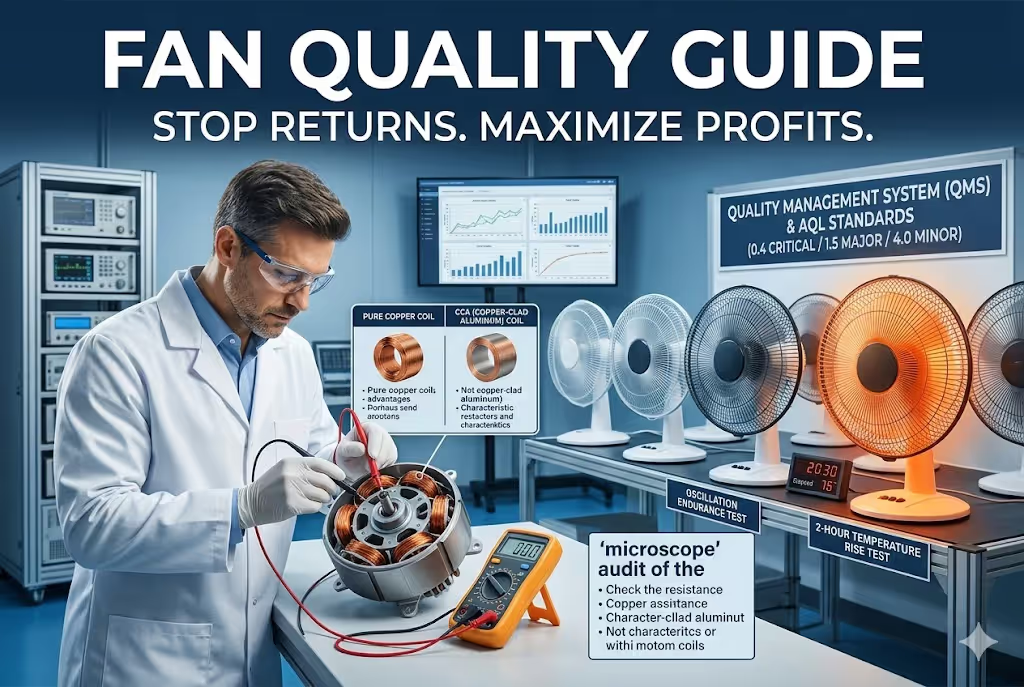
To fix this, wholesalers must audit motor materials, run 2-hour temperature tests, and use strict AQL standards.
Proper testing ensures products survive both the heat and the journey.
The guide below will show you exactly how to inspect your fans.
Follow these steps to keep your customers happy and your profit margins high.
Why Returns are the “Invisible Killer” for Wholesalers
Low quality leads to high returns that eat your profits fast.
Even a small 1% return rate can double your logistics costs.
You must fix quality issues before the fans ship.
A 1% return rate can reduce your net profit by 15% because of double shipping and storage fees.
“Factory pass” does not mean “customer happy.”
You need a system that tracks the real cost of every defect.
The Real Math of a Single Return
When a customer returns a fan, you do not just lose one sale.
You lose the money you spent to ship it to them.
Then, you pay to ship it back to your warehouse.
You also pay staff to inspect the broken fan.
Most of the time, the packaging is destroyed, so you cannot sell it as new.
These hidden costs add up quickly and can destroy a wholesale business.
Why “Factory Pass” Is Often a Lie
Many factories check if a fan turns on and call it “passed.”
This is not enough.
A fan might work for five minutes in a cool factory but fail after two hours in a hot living room.
If you only look at the final product, you miss the small mistakes that cause big problems later.
You need a deeper inspection process.
Table: The Hidden Costs of Poor Quality
| Cost Category | Direct Impact | Long-term Effect |
| Shipping | Double freight costs | Higher contract rates |
| Warehouse | Extra storage space used | Slower stock turnover |
| Brand | Refunds and claims | Loss of repeat customers |
| Labor | Time spent on emails | Higher overhead costs |
Protecting Your Brand Value
Quality is the best marketing tool you have.
When a fan works perfectly for years, the customer trusts your brand.
If it breaks in a month, they tell their friends not to buy from you.
You are not just selling a fan; you are selling a cool breeze and peace of mind.
To win, you must be more strict than the factory.
You must look at the tiny details that others ignore.
This builds long-term trust.
The “Microscope” Audit of Core Components
The motor is the heart of the fan.
If the motor fails, the fan dies.
You must check the wires and the bearings carefully to ensure a good lifespan for your target market.
Auditing fan motors requires checking wire material, measuring temperature rise after 2 hours, and verifying bearing types.
Different materials like pure copper, pure aluminum, and copper-clad aluminum offer different price and lifespan balances for various markets.
The Copper, Aluminum, and CCA Choice
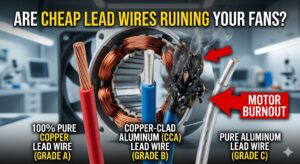
Factories use pure copper, pure aluminum, or copper-clad aluminum (CCA) for motor wires.
None of these are “wrong,” but you must pick the right one for your target price and customer.
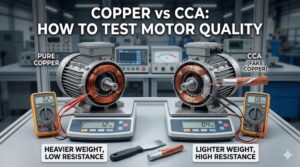
You can check the difference by testing the wire resistance or the weight of the motor.
- Pure Copper Motors: These are the most expensive. They are heavier and have the lowest resistance. They offer the longest lifespan and are best for premium brands.
- CCA Motors: This is a middle choice. They are lighter and cheaper than copper. They offer an acceptable lifespan for mid-range markets that need a balance of price and performance.
- Pure Aluminum Motors: These are the cheapest option. They have the highest resistance and get hot faster. They have a shorter lifespan but are suitable for strict budget markets where price is the only factor.
Understanding Temperature Rise
A fan motor should stay safe even after running for a long time.
We use “Class E” or “Class B” ratings to define safety.
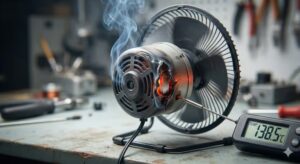
If a motor gets too hot after 2 hours of use, the internal insulation will melt.
This leads to smoke, fire, or a dead fan.
Always demand a “Temperature Rise Test” report from your supplier after a 2-hour run time.
Bearings and Noise Control
Noise is a major reason for customer complaints.
The type of bearing used determines how loud the fan is.
- Sleeve Bearings: Cheaper, but they dry out and get noisy over time.
- Ball Bearings: More expensive, but they run quietly for years.
Table: Motor Component Options
| Component | Budget Option | Premium Option |
| Wire Material | Pure Aluminum / CCA | 100% Pure Copper |
| Bearing Type | Sleeve Bearing | Dual Ball Bearing |
| Insulation | Class E (120°C) | Class B (130°C) |
| Housing | Recycled Plastic | New ABS or Metal |
You must choose the right parts for your business model.
A budget fan uses cheaper parts, while a premium fan uses expensive parts.
Just make sure the quality matches the price you charge.
Simulating Extremes: “Violence Testing” in the Lab
Fans face tough conditions in the real world.
They must survive voltage spikes, long hours of use, and rough delivery drops.
You need both lab tests and real-world tests to prove a fan is tough enough.
Testing includes oscillation tests for 10,000 cycles, Hi-Pot tests for electrical safety, 1.2-meter drop tests, and real-world running tests.
These steps make sure the fan works well and stays safe during daily use and rough handling.
The Oscillation Endurance Test
The turning mechanism is often the first thing to break.
We test this by forcing the fan to turn left and right for 5,000 to 10,000 cycles.
If the gears are weak, they will wear down and stop moving.
You want to see strong gears that handle years of movement without locking up.
Hi-Pot Tests for Global Safety
In many regions, the power grid is not stable.
A “Hi-Pot” (High Potential) test sends a strong burst of electricity through the fan.
This makes sure it does not leak power.
This protects the customer from electric shocks.
If a fan fails this test, the whole batch must be rejected.
The 1.2-Meter Drop Test
Online delivery is rough.
Boxes are thrown and dropped.
A 1.2-meter drop test simulates a fan falling off a truck.
- The Grill: Should not bend or touch the blades.
- The Blades: Must not crack or shatter.
- The Base: Must stay attached and not snap.
Real-World Lifestyle Testing
Lab machines are great, but real homes are different.
You should also run tests in normal living conditions.
Turn the fan on for 8 to 12 hours every day.
Keep doing this for 1 to 3 months.
This shows you exactly what the customer will experience during a hot summer.
It reveals slow-failing parts that a quick lab test might miss.
Why Lab Tests Build Brand Premium
You must understand that not every fan needs to pass the highest laboratory standards.
If you force every basic fan to meet strict rules, the cost will be very high.
The mass market might not accept the high retail price.
However, if you choose to build a fan that passes all these strict tests, you create a high brand premium.
Customers will pay more money for a fan they know will last.
Lab reports give you the proof to sell at that higher price.
Building Your AQL Inspection System
You cannot just tell a worker to “look at the fans.”
You need a clear system with numbers and rules.
This is called the Acceptable Quality Limit (AQL), and it defines what is a “fail.”
AQL rules group mistakes into Critical (0.4), Major (1.5), and Minor (4.0).
Using these specific numbers allows buyers to make clear “Pass/Fail” decisions based on data, not just feelings or quick glances.
Defining the Three Types of Defects
Not every mistake is the same.
A small scratch is not as bad as a motor that catches fire.
You must separate the problems.
- Critical Defects (AQL 0.4): These are safety risks, like exposed wires. If you find even one, the whole shipment is rejected.
- Major Defects (AQL 1.5): These are functional problems, like a broken remote. Too many of these will hurt your sales.
- Minor Defects (AQL 4.0): These are small visual issues, like a tiny scratch on the back.
Checking the Appearance
The first thing a customer sees is the plastic.
You must check for sharp extra plastic and color changes.
If the fan looks cheap, the customer will expect it to break.
Good mold work means the parts fit together perfectly with no large gaps.
This makes the fan look valuable.
Functional Double-Check
The worker must test every button.
Does the timer work?
Does the remote reach far enough?
Does the fan tilt correctly?
These are the features the customer wants.
If they do not work, the customer will return the product.
Table: Sample AQL Inspection Sheet
| Defect Type | Description | Max Allowed (Batch of 1000) |
| Critical | Electric shock risk | 0 |
| Major | Motor will not start | 7 |
| Minor | Small scratch on grill | 14 |
Having this table makes your inspection fast and simple.
There is no arguing with the supplier.
The batch either passes the AQL test, or it stays at the factory to be fixed.
Packaging and Shipping: The Final Defense
A perfect fan is useless if it arrives broken.
The trip across the ocean is long, wet, and bumpy.
Your box must be strong enough to protect your product until it reaches the buyer.
Good fan packaging must block moisture from “container sweat” and handle heavy stacking weight.
Using strong corrugated cardboard and silica gel stops the box from breaking and keeps mold away during long trips.
Managing Humidity and “Container Sweat”
When a shipping container moves through different weather, the air inside gets wet.
This is called “container sweat.”
If your boxes are weak, they absorb this water and get soft.
Soft boxes crush under the weight of other fans.
You must use strong, export-grade cardboard that handles high humidity well.
Stackability and Pressure
Inside a container, boxes are piled high to save money.
The boxes at the bottom hold hundreds of kilograms of weight.
- Avoid Over-Stacking: Follow the height limit printed on the box.
- Use Corner Protectors: These make the box much stronger.
- Tight Loading: Make sure there are no empty spaces where boxes can slide or fall over.
The Importance of the “Squeeze Test”
Fan blades are thin and easy to bend.
If a heavy box squeezes your package, the metal grill might push into the blade.
When the customer turns it on, it will make a loud scraping noise.
The inside foam or cardboard must keep the blade and grill far apart at all times.
Table: Packaging Checklist
| Item | Requirement | Goal |
| Box Material | 5-ply Corrugated Cardboard | Strength and safety |
| Tape | H-style Taping | Strong seal |
| Silica Gel | 2-3 packets per box | Stop moisture |
| Inner Foam | Custom-molded parts | Block shocks |
By checking the packaging, you make sure your quality control work is not wasted.
A clean, strong box also makes the customer feel good about their purchase.
Conclusion
Quality is a daily choice, not an accident.
Use clear tests and strict rules to lower your return rates, protect your profits, and build a strong brand premium in the market.
FAQ
How can I tell the difference between copper and aluminum motors?
You can weigh the motor, as copper is heavier than aluminum.
You can also test the wire resistance with a tool; aluminum has a higher resistance than copper.
What is a normal return rate for electric fans?
A return rate of 1% to 2% is very good for consumer electronics.
If your return rate goes over 3%, you likely have a major quality problem.
What does AQL 1.5 mean for my orders?
AQL 1.5 means you allow a maximum of 1.5% major defects in a test sample.
If the inspector finds more broken items than this limit, you reject the whole order.
Why do electric fans stop turning left and right?
This happens when the small plastic gears inside the motor wear out or break.
It can also happen if the parts lack oil or if the fan head is blocked.
How do I test if my fan packaging is strong enough?
You should do a drop test from 1.2 meters high on all sides of the box.
You should also do a squeeze test to make sure the box does not crush easily.
Is a ball bearing fan worth the extra cost?
Yes, if you want to sell a premium product.
Ball bearings handle heat better, run quietly, and last much longer than standard sleeve bearings.
How long should a temperature rise test run?
A standard temperature rise test for an electric fan motor should run for at least 2 hours.
This checks if the motor stays within safe heat limits during use.
Would you like to review this formatting to ensure it perfectly matches your website’s styling requirements, or is there anything else you’d like adjusted?