High shipping costs and rising taxes are eating your fan business profits.
Don’t let logistics ruin your margins.
Switch to CKD shipping and save your business money starting today.
Switching to CKD can reduce fan shipping costs by 50% to 70%.
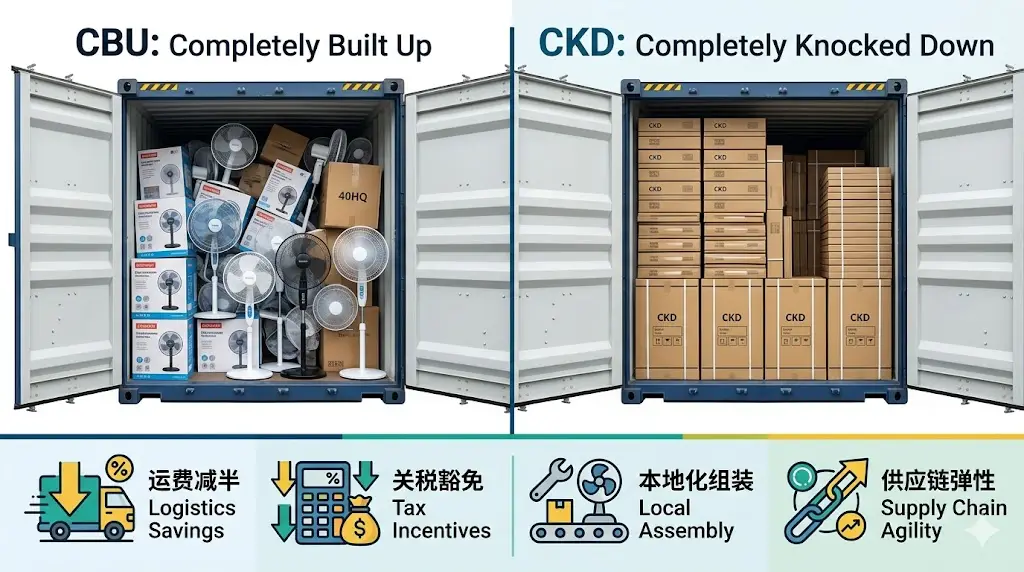
By shipping parts instead of assembled units, you fit 2.5 times more products in one container.
This drastically lowers freight costs per unit and avoids high finished-good taxes.
Many successful fan sellers are moving away from importing ready-to-sell fans.
They want to keep their prices low and their profits high.
Keep reading to learn how this simple change can transform your business in 2026.
Why You Can’t Just Import Finished Fans in 2026
Shipping costs are rising and trade wars are getting much worse.
Importing finished fans is becoming too expensive for most small and medium businesses.
You need a smarter way to survive.
In 2026, importing finished fans (CBU) is risky due to high sea freight and rising protectionist tariffs.
Many countries now favor local assembly.
This makes pure imports less profitable and harder to clear through customs safely.
The global market for electric fans has changed very quickly over the last few years.
In the past, you could simply order a container of finished goods and wait for it to arrive.
Today, the world faces many economic challenges that make this old way of working very risky.
Sea freight prices have become very unstable because of global events.
When you import a finished fan, you are mostly paying to ship empty space.
A typical 16-inch stand fan has a large plastic guard and a heavy base.
If the fan is already built, it must go into a large box to protect the parts from breaking.
This means a single shipping container can only hold a small number of units.
You are paying thousands of dollars to ship air across the ocean.
The Problem with Protectionist Tariffs
Governments around the world want to grow their own local industries.
They do this by placing high taxes on finished products that come from other countries.
These taxes are often called “protectionist tariffs” because they protect local workers.
If you bring in a fan that is ready to use, the customs office will charge you the highest tax rate possible.
In many regions like Southeast Asia or Africa, these taxes are designed to make imported fans more expensive than local ones.
Logistics Risks in 2026
- Unpredictable Freight: Container prices can change by 50% in just one week.
- Port Delays: Finished goods often face more inspections at customs than raw parts do.
- Storage Costs: Large boxes of finished fans take up huge amounts of space in your warehouse.
You must look at your profit margins with a critical eye.
If your shipping cost per unit is more than 15% of your sale price, your business model is in danger.
Relying on CBU imports makes you a target for every new tax law.
By shifting to a parts-based model, you move away from these high-risk categories.
You gain more control over your costs and your future.
Understanding CBU vs SKD vs CKD for Electric Fans
Confused by industry jargon like CKD or SKD?
Using the wrong shipping method costs you thousands of dollars every year.
Learn the difference between these three methods to fix your supply chain now.
CBU is a fully assembled fan ready to use. SKD involves shipping large parts like motors and bases separately in one box.
CKD is the complete breakdown into individual parts, offering the highest shipping density and lowest taxes.
When you talk to manufacturers, they will offer you three different ways to buy your fans.
Each way has a different impact on how much space you use and how much tax you pay.
It is important to choose the right one for your specific warehouse and team.
CBU: Completely Built Up
This is the most common method for beginners.
The fan is fully put together at the factory.
It is placed in a colorful retail box with your brand name on it.
You receive the container, take out the boxes, and put them on a truck to the store.
While this is easy, it is the least efficient way to use a shipping container.
You cannot stack these boxes very high because the weight of the fans might crush the bottom boxes.
SKD: Semi-Knocked Down
This is a middle-ground solution for businesses that want to save space but don’t want to build a factory.
In this model, the factory does the hard work like assembling the motor.
The fan is shipped in 3 or 4 large pieces.
The motor head is one piece, the base is another, and the guards are nested together.
You can fit about 30% more fans in a container using SKD compared to CBU.
However, many countries still tax SKD fans at the same rate as finished fans.
CKD: Completely Knocked Down
This is the ultimate strategy for high-volume sellers.
Every single screw, wire, and plastic part is packed separately.
The motors are packed in dense blocks.
The plastic blades are stacked on top of each other like spoons.
The metal guards are pressed together to use every inch of space.
| Feature | CBU (Finished) | SKD (Semi) | CKD (Parts) |
| Shipping Space | Very High | Medium | Very Low |
| Import Tax | Highest | Medium | Lowest |
| Assembly Needed | None | Low | High |
| Profit Margin | Low | Medium | High |
| Tools Needed | None | Basic | Professional |
You should use critical thinking to decide if your team is ready for CKD.
CKD requires you to have a small assembly area and basic quality control.
If you sell more than 10,000 fans a year, CKD is almost always the best choice.
The savings on just one container can pay for the tools you need.
It allows you to customize the fan locally, such as using different power cords for different markets.
The Math of Profit: How CKD Saves Shipping and Tax
Every empty space in your shipping container is lost money.
Stop paying to ship air across the ocean.
Learn how CKD turns that wasted space into pure profit for your fan business.
CKD saves money by maximizing container space, fitting up to 5,000 fans instead of only 2,000.
Additionally, most countries charge 10% to 20% less duty on fan parts than on finished fans, boosting your total profit margins significantly.
Let’s look at the actual numbers to see how much money is at stake.
The shipping container is like a rented room; you pay the same price whether it is full or empty.
If you ship finished fans, you are wasting over 60% of the room inside that container.
Parts are much smaller and can be packed much more efficiently.
Breaking Down the Shipping Math
Imagine a standard 40-foot high-cube (40HQ) container.
If you ship finished 16-inch stand fans, you can fit roughly 2,100 units.
If the container cost is $4,200, you are paying $2.00 per fan just for the ride across the sea.
Now, look at the CKD model for the exact same fan.
Because the parts are flat and stackable, you can fit about 5,200 units.
With the same $4,200 container, your cost per fan drops to $0.80.
You have just saved $1.20 in pure profit before the fan even arrives at your door.
The Tax Advantage
Tax laws are the second place where you save a lot of money.
Most countries use the Harmonized System (HS) to decide how much tax you pay.
Finished fans (HS Code 8414.51) often have a “luxury” or “finished good” tax.
However, parts like electric motors (HS Code 8501) or plastic parts (HS Code 3926) have much lower rates.
- Finished Fan Import Duty: Often 20% to 35%.
- Fan Parts Import Duty: Often 0% to 10%.
Example Cost Table
| Cost Item | CBU (Per Unit) | CKD (Per Unit) | Savings |
| Ocean Freight | $2.00 | $0.80 | $1.20 |
| Import Duty (25% vs 5%) | $3.75 | $0.75 | $3.00 |
| Local Labor Cost | $0.00 | $0.50 | -$0.50 |
| Total Cost Impact | $5.75 | $2.05 | $3.70 |
If you sell 50,000 fans a year, saving $3.70 per fan means an extra $185,000 in your pocket.
Even after you pay for local workers to build the fans, you are still far ahead.
This extra money can be used to lower your prices and take market share from your competitors.
It can also be used for marketing to help your brand grow faster.
Setting Up Your Local Fan Assembly Line: A Practical Guide
Think building a factory is too hard and expensive?
You are missing out on huge tax breaks and savings.
Setting up a local fan assembly line is much easier and cheaper than most people think.
To start local assembly, you only need basic tools like electric screwdrivers, a simple conveyor belt, and testing racks.
Standardized operating procedures (SOPs) allow junior workers to assemble fans quickly with only a few hours of training.
Many business owners are afraid of the word “manufacturing.”
They imagine giant machines and millions of dollars in investment.
For electric fans, the reality is much simpler and more accessible.
A fan assembly line is mostly about putting a few parts together with screws.
What Do You Actually Need?
You do not need a high-tech facility to get started.
A clean, well-lit warehouse with a flat floor is enough.
You will need a series of long tables where workers can stand and work.
Each worker will have one specific job to do.
- Electric Screwdrivers: These are the most important tools.
- Air Compressors: To power the screwdrivers and clean the parts.
- Testing Equipment: You must check the electricity to make sure the fan is safe.
- Packing Tables: To put the finished fan into its final box.
Creating a Simple Process
The secret to a good assembly line is a Standard Operating Procedure (SOP).
An SOP is a simple set of instructions with pictures for every step.
By breaking the work into small pieces, any worker can learn the job in one morning.
For example, one person only puts the motor onto the stand.
The next person only connects the wires.
The third person only puts on the fan blades and the grill.
Quality Control and Safety
You must be careful about quality when you assemble locally.
It is your responsibility to make sure the fans are safe for customers.
You should have a “Burn-in Room” where you leave some fans running for 24 hours.
This helps you find any motors that might have problems before they leave your warehouse.
You also need to perform a “High-Pot Test” to check for electrical leaks.
These steps are easy to do and ensure that your brand stays strong and trusted.
Beating Trade Barriers with “Made in Local” Status
Anti-dumping duties can shut down your fan business overnight.
Don’t let trade barriers stop your growth and sales.
Use CKD to gain “local status” and protect your market share from high taxes.
CKD allows your products to be labeled as “locally manufactured” or “assembled in your country.”
This status helps you avoid high anti-dumping duties and makes you eligible for government contracts and local business tax incentives.
Trade politics are a major risk for anyone who imports goods.
Governments often change their rules to block products from specific countries.
They use tools like “Anti-Dumping Duties” which can add 50% or even 100% to your costs.
If you are just a trader who buys finished fans, you have no way to fight these taxes.
But if you are an assembler, you have a powerful advantage.
The Power of Local Origin
When you assemble a fan in your own country, it changes its legal identity.
Customs laws usually say that if you perform “substantial transformation,” the product is now local.
This means you can get a Certificate of Origin from your local Chamber of Commerce.
With this document, you are no longer an “importer of foreign goods.”
You are a “local manufacturer.”
Why This Matters for Sales
- Avoid Trade Wars: If your country starts a trade war with the country where the parts come from, parts are usually the last thing to be taxed.
- Government Bids: Many large buyers like schools or offices are required to buy from local companies.
- Tax Credits: Some governments will actually give you money back for every job you create.
Building Long-Term Security
Think about the long-term health of your business.
A company that owns its own assembly process is much harder to replace than a company that just buys and sells.
You can adapt to new laws much faster than your competitors.
If one country becomes too expensive to buy parts from, you can buy parts from a different country.
Your assembly line stays the same, and your business keeps running.
This flexibility is the best way to survive in a world where trade rules change every day.
Conclusion
CKD is the smartest way to import fans in 2026.
It cuts shipping costs, lowers taxes, and protects your business from trade risks.
Start your transition to CKD today for higher profits.
FAQ
What is the difference between CKD and SKD for fans?
CKD means every single part is separate and needs full assembly.
SKD means the fan is partially put together, like the motor already being inside the plastic housing.
How many CKD fans fit in a 40HQ container?
Usually, you can fit between 4,500 and 5,200 standard 16-inch stand fans in a 40HQ container using CKD.
This is double the amount of finished fans (CBU).
Is local assembly of fans difficult for beginners?
No, it is very simple.
Fan assembly uses basic tools and easy steps.
With a clear picture guide, new workers can learn the process in just a few hours.
Does CKD reduce import duty significantly?
Yes, most countries charge much lower taxes on parts than on finished products.
You can often save 15% to 20% on total import duties by switching to CKD.
What equipment is needed for a CKD fan line?
You need electric screwdrivers, assembly tables or a conveyor, a power testing station, and basic packing tools.
The total setup cost is generally very low.
Why is CKD better than CBU for long-term growth?
CKD lowers your per-unit cost and protects you from high “anti-dumping” taxes.
It also allows you to label your products as locally made, which builds better brand trust.
Do I need a big factory for CKD?
No, a small warehouse is enough.
You just need space for the parts, a few assembly tables, and a small area to store the finished fans before they ship.
How do I handle quality control with CKD?
You should implement a testing station at the end of your line to check electrical safety and motor function.
Keeping a record of serial numbers also helps track any issues that might arise.