Is your fan loud but barely pushing any air?
It is frustrating when you need to cool down, but your fan just makes noise without relief.
The problem is often not the motor, but the design of the fan blade itself.
Fan blades are the most critical component of a household fan after the motor.
Their performance depends on specific factors like size, shape, pitch angle, weight, and material type.
Understanding these elements helps you choose the right fan for cooling and durability.
Let’s look closer at these five specific features to understand how they change the way your fan works.
Dimensions
Buying the wrong size fan wastes money and valuable floor space.
A tiny fan in a large living room feels useless, while a massive fan in a small room is overwhelming.
You need to match the physical size to your actual cooling needs.
Fan size usually refers to the diameter of the blade itself, not the wire cage.
Common household sizes range from 9 inches (225mm) for desks to 20 inches (500mm) for large rooms.
Larger blades move more air but require more space.
When we talk about the size of a fan, we are strictly talking about the diameter of the blade sweep.
This is the circle the blades make when they spin.
It is important to know the metric conversion because different brands list sizes differently.
Here is a quick reference guide for common household sizes:
| Fan Blade Size (Inches) | Fan Blade Size (Millimeters) | Best Use Case |
| 9 Inch | 225mm | Personal desk fans |
| 12 Inch | 300mm | Small bedrooms or tabletops |
| 14 Inch | 350mm | Standard bedrooms |
| 16 Inch | 400mm | Living rooms and dining areas |
| 18 Inch | 450mm | Large open spaces |
| 20 Inch | 500mm | Workshops or very large rooms |
Why Size Matters
The size of the blade dictates the volume of air moved.
A 16-inch (400mm) fan is the standard for most homes because it offers a good balance.
It fits in a corner but pushes enough air to cool a group of people.
However, bigger is not always better.
A 20-inch (500mm) fan moves a lot of air, but it can be too noisy for sleeping.
On the other hand, a 9-inch (225mm) fan is quiet, but it provides a very focused beam of air.
You must choose the size based on the room size and how close you will sit to the fan.
If you sit far away, you need a larger diameter to feel the breeze.
Shape
Do you hate that choppy, buffering feeling from standard fans?
Some fans feel rough on your skin, almost like they are slapping you with wind.
The specific shape and number of the blades change how the air actually feels on your body.
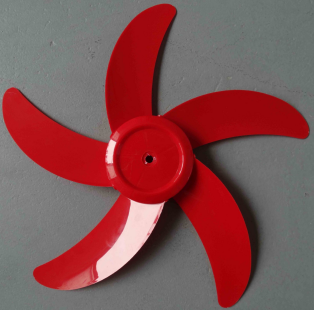
Household fans typically use 3, 4, 5, 6, or 7 blades.
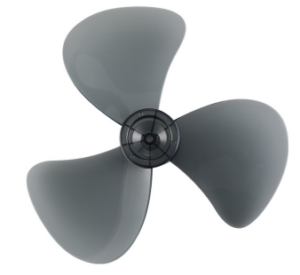
The design of these blades varies, often resembling shapes like lotus leaves, scimitars, or banana leaves.
The number and shape of the blades directly affect airflow smoothness and noise levels.
The shape of the blade is about more than just looks.
It changes the aerodynamics of the fan.
Manufacturers use nature-inspired designs to solve noise and efficiency problems.
Common Blade Shapes
- Lotus Leaf: These are often wider and rounded. They tend to push a softer volume of air.
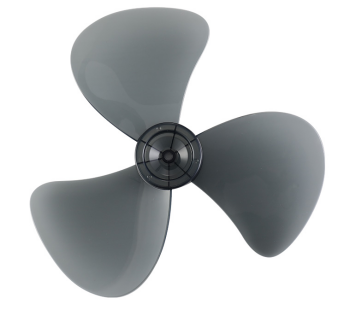
- Scimitar (Guan Dao) / Broadsword: These are sharp and curved. They cut through the air aggressively to create strong wind.
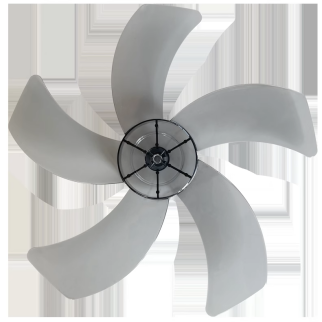
- Banana Leaf: These are long and narrow. They are often used for specific aesthetic styles or specialized airflow patterns.
Blade Count and Comfort
There is a big debate about the number of blades.
- Few Blades (3 leaves): These are common in industrial or cheap fans. They tend to be louder and the wind feels “hard.”
- Many Blades (5 to 7 leaves): These cut the air into smaller chunks. This makes the wind feel “soft” and smooth.
If you want a fan that feels like a natural breeze, look for more blades with a Lotus shape.
If you want raw power to dry a wet floor, a 3-blade Scimitar shape is likely better.
The shape determines if the fan creates a gentle breeze or a strong tunnel of wind.
Angle
Does your fan spin fast but seemingly push no air at all?
It is annoying to hear the motor running hard with zero results.
This inefficiency is often a direct result of the blade pitch angle.
The blade angle, or pitch, usually ranges from 10 to 18 degrees.
Steeper angles move more air and require more power from the motor.
Flatter angles use less power but produce a weaker breeze.
The motor must always be tuned to match this angle.
The angle of the blade (the twist) acts like a scoop.
It determines how much air the blade grabs with every rotation.
The Relationship Between Angle and Power
Think of the angle like the gears on a bicycle.
- Low Angle (10° – 12°): This is like a low gear. It is easy for the motor to spin, but it does not move much air. The power consumption is low.
- High Angle (16° – 18°): This is like a high gear. It grabs a lot of air (“scoops” a bigger bite). This creates strong wind, but it is heavy work.
The Importance of Motor Tuning
You cannot simply put a high-angle blade on any random motor.
The motor must be “tuned” or rated for that load.
- The Risk: If you put a steep 18-degree blade on a weak motor, the motor will struggle. It will overheat and eventually burn out.
- The Result: If the motor is strong enough, a high angle increases the wattage (power used) and the wind force.
Manufacturers have to find a balance.
They want to give you the strongest wind possible without making the electricity bill too high or killing the motor.
This is why you should never replace a broken fan blade with a generic one unless you know the angles match.
Weight
Is your fan vibrating or “walking” across the floor?
Heavy, unbalanced blades cause instability and annoying rattling noises.
The physical weight of the fan blade matters much more than you might think for smooth operation.
Generally, heavier fan blades generate stronger wind but demand higher power wattage.
Lighter blades use less energy but push less air.
However, engineers can sometimes adjust the blade angle to achieve strong airflow even with lighter materials, balancing efficiency and performance.
Weight plays a huge role in momentum and inertia.
A heavy object is hard to start moving, but once it moves, it carries a lot of force.
The Trade-Offs of Weight
- Heavy Blades: These require a powerful motor to start spinning. Once they are at speed, they are very stable and push hard. This usually results in higher wattage (power consumption) and stronger wind.
- Light Blades: These spin up instantly. They use less electricity. However, they can feel flimsy and might not throw the air as far.
The Engineering “Cheat Code”
Interestingly, manufacturers can manipulate the relationship between weight and wind.
Note: A lighter blade does not always mean weak wind.
If a manufacturer wants to save money on materials or shipping weight, they might use a lighter plastic.
To compensate for the lack of weight, they will increase the Angle (as discussed in the previous section).
By making the blade steeper, a light blade can still scoop a lot of air.
This achieves the same wind force as a heavy blade but keeps the material costs down.
It is a delicate balance of physics to ensure the fan remains stable and does not vibrate.
Material
Has your old fan stopped blowing cool air even though it spins?
It is confusing when the motor runs fine, but the wind seems to have disappeared.
The blade material might have deformed over time due to heat or stress.
Household fan blades are mostly made from three plastic types: PP, AS, and ABS.
PP is soft and cheap, AS is stiff but brittle, and ABS offers the best durability.
Choosing the right material prevents deformation and extends the lifespan of your fan.
The material of the blade is the biggest factor in how long the fan will last and how much it costs.
Here is a breakdown of the three most common materials found in stores.
1. PP (Polypropylene)
This is the budget option.
- Pros: It is very cheap. It is also flexible, so it rarely cracks.
- Cons: It is too flexible. Over time, the centrifugal force and air resistance cause the blade to flatten out.
The “No Wind” Problem
When a PP blade flattens, it loses its angle.
The fan spins, but the air goes nowhere.
This is the main reason old fans stop working well.
2. AS (Acrylonitrile Styrene)
This is the standard mid-range option.
- Pros: It is very stiff and holds its shape well. It is often clear or transparent blue. The price is reasonable.
- Cons: It is brittle. If you knock the fan over, an AS blade will likely shatter like glass.
3. ABS (Acrylonitrile Butadiene Styrene)
This is the premium option.
- Pros: It combines the best of both worlds. It is strong like AS but flexible enough not to break easily. It keeps its shape for years.
- Cons: It is expensive. Because of the high cost, it is harder to find in cheap supermarkets.
Comparison Table
| Material | Deformation Risk | Impact Resistance | Cost | Verdict |
| PP | High (Flattens) | High (Won’t Break) | Low | Good for temporary use |
| AS | Low (Stays Shape) | Low (Shatters) | Medium | Good value, handle with care |
| ABS | Very Low | High | High | The best investment |
Conclusion
The blade is the heart of the fan’s performance.
When choosing a fan, look for ABS material for longevity, a 16-inch size for general use, and a blade shape that fits your preference for soft or strong wind.
Are you looking for reliable fan blades for your assembly line?
Our factory specializes in manufacturing high-performance blades with precise angles and durable materials.
Contact us today to discuss your specifications and get a custom quote.