

The Ultimate Guide to Fan Guards: Types, Sizes, and Wire Specs
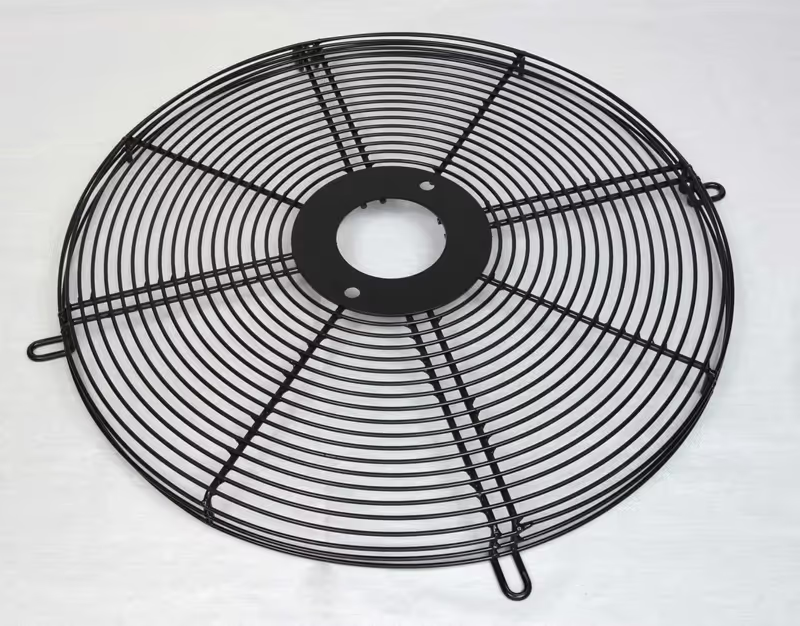
Table of Contents
Introduction
Most buyers spend weeks on the motor and the blades, then leave the fan guard to the last email. That is a mistake. The guard is the part your customer touches first, the part that decides whether the fan passes a finger-access test, and the part suppliers cut corners on most often — thinner wire, fewer wires, cheaper paint.
This guide covers everything you need to specify a guard correctly: the three standard shapes, how guard diameter relates to fan size, what wire count and wire diameter actually mean, the three ways a guard can be fixed, how surface finish behaves in humid markets, and what to inspect before shipment. It applies to table fans, wall fans, stand (pedestal) fans, orbit fans, box fans and industrial metal fans.
Three facts worth remembering before you read on:
- Guard OD is not blade size. For example, a “16-inch” fan has a 400 mm blade but takes a Ø430 mm or Ø445 mm guard.
- Wire diameter includes the paint. Powder coating adds roughly 0.1 mm, so a “1.2 mm” wire measures about 1.1 mm before coating.
- Wire count controls safety. On the same guard diameter, more wires mean smaller openings and a better chance of passing finger-access tests.
What Is a Fan Guard?
A fan guard — also called a fan grille, wire guard or wire grille — is the wire structure that shields the blades. It does three jobs: it keeps fingers, hair and objects out of the rotating blades, it protects the blades from impact, and it gives the fan its finished look.
Household fans normally use a two-piece set: a rear guard that mounts to the motor, and a front guard that locks onto the rear one. Industrial metal fans usually use a single-piece spiral guard. Box fans are the exception — they have no wire guard at all, because a rotary louvre panel covers the blade instead.
| Part | What it is | Why buyers ask about it |
|---|---|---|
| Outer ring / rim | The stiff ring that forms the guard edge | Sets the guard OD; visible quality cue |
| Spokes (radial wires) | Wires running from the hub out to the ring | Spoke count affects strength and cost |
| Concentric rings | Rings between hub and rim | Increase opening density for safety tests |
| Centre hub | Centre plate at the middle of the guard | Carries the brand plate or colour accent |
| Clips | Steel hooks that lock front guard to rear guard | Decide whether the guard is tool-free |
| Front / rear guard | The two halves of a household guard set | Usually quoted as a set, not a single piece |
The Three Guard Styles: Radial, Spiral and Fishnet
Guard shapes are not cosmetic. Each style solves a different problem, and choosing the wrong one either raises your cost or fails a safety test.
Radial guards — the standard choice
Radial (also called “radiation” style) is the most common guard. Wire spokes run from the centre hub to the outer ring, with a few concentric rings holding them in place. Tooling is simple, cost is low, and it fits almost any fan.
Reference sizes:
| Fan size | Guard OD |
|---|---|
| 9″ | 270 mm |
| 12″ | 340 mm, 355 mm |
| 14″ | 410 mm |
| 16″ | 430 mm, 445 mm |
| 18″ | 500 mm |
| 20″ | 548 mm, 560 mm |
| 26″ | 670 mm, 688 mm, 710 mm |
| 30″ | 770 mm, 788 mm, 810 mm |
Spiral guards — heavy-duty and industrial
Spiral guards are wound from a continuous wire, so they are stiffer than radial guards of the same wire diameter. They are the normal choice for industrial fans from 20″ to 30″, and they are more expensive. If a fan runs in a workshop, warehouse or livestock shed, this is the guard to specify.
Fishnet (diamond) guards — for home safety
Fishnet guards use a denser wire pattern. They exist for one reason: safety certification. A radial guard can pass a strict finger test, but only if the wires are thick and close together — which makes the guard heavy and expensive. A fishnet guard passes the same test with less material. They are used mainly on household sizes from 12″ to 18″.
| Style | Strength | Cost | Best for | Passing finger tests |
|---|---|---|---|---|
| Radial | Medium | Low | Table, wall, stand and orbit fans | Needs the right wire count and wire diameter |
| Spiral | High | Higher | Industrial pedestal and wall fans | Needs 7 mm pitch to pass finger tests |
| Fishnet / diamond | Medium | Medium | Household fans 12″–18″ | Easiest to pass |
Fan Guard Sizes: Blade Size vs Guard OD
This is the single most common source of disputes between buyers and factories.
Buyers think in fan size — 12″, 16″, 18″, 20″. Factories build guards to an outer diameter in millimetres. The guard is always larger than the blade, because it has to clear the blade tips and hold its own shape.
| Fan size | Blade Ø | Guard OD | How it is sold in the EU / Japan | How it is sold in Latin America |
|---|---|---|---|---|
| 9″ | 230 mm | 270 mm | 23 cm | 9 pulgadas |
| 12″ | 300 mm | 340 mm | 30 cm | 12 pulgadas |
| 14″ | 350 mm | 410 mm | 35 cm | 14 pulgadas |
| 16″ | 400 mm | 430 mm, 445 mm | 40 cm | 16 pulgadas (40 cm) |
| 18″ | 450 mm | 500 mm | 45 cm | 18 pulgadas |
| 20″ | 500 mm | 560 mm (radial), 548 / 560 mm (spiral) | 50 cm | 20 pulgadas |
| 26″ | 650 mm | 670 mm, 688 mm, 710 mm | 65 cm | 26 pulgadas |
| 30″ | 750 mm | 770 mm, 788 mm, 810 mm | 75 cm | 30 pulgadas |
Two practical consequences:
- If your customer measures the guard with a tape and expects 400 mm on a 16″ fan, they will call it a defect. Explain the difference on your product page, not in your after-sales emails.
- If you sell the same fan in Europe and Latin America, quote the same fan as “40 cm” in one market and “16 pulgadas” in the other. The guard does not change — only the label does.
Wire Count and Wire Diameter
A guard specification on a Chinese price list looks like this:
430 × 120 × 1.2 mm
That is not a dimension chain. It reads: Ø430 mm guard, 120 wires, 1.2 mm wire. Read it the wrong way and you will reject good guards or accept weak ones.
Wire count
Wire count is the total number of wires in the guard. On the same outer diameter, more wires mean smaller openings between them — and smaller openings are what keeps fingers out and helps the guard pass finger-access testing.
Typical counts, by guard size:
- Ø340 mm (12″): 76, 80, 94 or 100 wires
- Ø430 mm (16″): 108 or 120 wires
- Ø445–500 mm (16″–18″): 120 or 135 wires
- Ø560 mm (20″): 135 wires
The density difference is visible side by side, and wire count is the first thing a quality inspector should check against the approved sample.
Wire diameter
Wire diameter sets how stiff the guard is. Thin wire is cheaper but bends, and a bent guard can touch the blades. The usable range:
- Household fans: 1.2–1.4 mm (economy builds start at 1.0–1.1 mm, certified builds typically 1.4 mm and up)
- Industrial fans: 1.4–2.0 mm, with extra support bars on very large sizes
One detail that causes arguments: coating
Wire diameter is normally quoted with the coating included. Powder coating adds about 0.1 mm, so a nominal 1.2 mm wire measures roughly 1.1 mm bare.
Put this in writing in your specification and your purchase order. If you order “1.2 mm” and your inspector measures bare wire, the shipment will look 0.1 mm thin even though nothing is wrong.
Guard range
The table below is the guard range we build and quote most often. Use it as a reference when you compare suppliers.
| Guard OD | Wire count | Wire Ø (coating included) | Style |
|---|---|---|---|
| 340 mm | 76 | 1.2 mm | radial |
| 340 mm | 80 | 1.2 mm | radial |
| 340 mm | 94 | 1.2 mm | radial |
| 340 mm | 100 | 1.2 mm | radial |
| 430 mm | 108 | 1.2 mm | radial |
| 430 mm | 120 | 1.2 mm | radial |
| 430 mm | 120 | 1.3 mm | radial |
| 445 mm | 120 | 1.3 mm | radial (table fans) |
| 445 mm | 120 | 1.4 mm | radial (orbit fans, clip-on) |
| 500 mm | 120 | 1.3 mm | radial |
| 500 mm | 135 | 1.3 mm | radial |
| 500 mm | 120 | 1.4 mm | radial (orbit fans, clip-on) |
| 560 mm | 135 | 1.4 mm | radial |
| 548–560 mm | spiral, 8 / 10 / 14 mm pitch | 1.4 / 1.8 / 2.0 mm | spiral (20-inch fans) |
| 670–710 mm | spiral, 8 / 10 / 14 mm pitch | 1.4 / 1.8 / 2.0 mm | spiral (26-inch fans) |
| 770–810 mm | spiral, 8 / 10 / 14 mm pitch | 1.4 / 1.8 / 2.0 mm | spiral (30-inch fans) |
Application: which guard fits which fan
| Fan type | Fan size | Guard OD / wire count / wire Ø | Fixing |
|---|---|---|---|
| Table fan | 12″ | 340 / 100 / 1.2 | plastic nut, clip-on or screw ring |
| Table fan | 16″ | 430 / 108 / 1.2; 430 / 120 / 1.2; 445 / 120 / 1.3 | plastic nut, clip-on or screw ring |
| Wall fan | 12″ | 340 / 100 / 1.2 | plastic nut, clip-on or screw ring |
| Wall fan | 16″ | 430 / 108 / 1.2; 430 / 120 / 1.2; 430 / 120 / 1.3 | plastic nut, clip-on or screw ring |
| Wall and stand fan | 18″ | 500 / 120 / 1.3; 500 / 135 / 1.3 | plastic nut, clip-on or screw ring |
| Stand (pedestal) fan | 20″ | 560 / 135 / 1.4 | plastic nut, clip-on or screw ring |
| Box fan | 10″–16″ | no wire guard (rotary louvre) | — |
| Orbit fan | 16″ | 445 / 120 / 1.4 | clip-on |
| Orbit fan | 18″ | 500 / 120 / 1.4 | clip-on |
| Industrial fan (pedestal / wall) | 20″ / 26″ / 30″ | 548 / 560 (20″); 670 / 688 / 710 (26″); 770 / 788 / 810 (30″); Ø570 for wall fans | round-edge or steel self-clip, tool-free |
How the Guard Attaches: Plastic Nut, Clip-On or Screw Ring
There are two joints to think about, and buyers usually only ask about the first.
Rear guard to motor. The rear guard is centred on the motor front cover and held by screws, sometimes with a clamping ring. This joint is model-specific and normally not a sourcing decision.
Front guard to rear guard. This is where you have a choice, and where your product positioning is decided:
- Plastic nut (screw-on). A plastic cap or nut at the centre hub pulls the front guard onto the rear guard. Cheap, familiar, but the customer needs to unscrew it — and plastic nuts crack when over-tightened.
- Clip-on. Steel clips on the rear guard catch the front guard. No tools, no loose parts to lose, and the guard comes off in seconds for cleaning.
- Screw ring. The front guard is clamped by a metal ring with screws. The most secure option and common on larger or industrial fans, but the slowest to remove.
For retail products, clip-on is the specification to ask for. “Tool-free”, “easy-clean” and “unclips in seconds” are real selling points on a product page, and they cost very little at the factory. On our household guards, all three fixing methods are available — pick one and freeze it in the approved sample, because mixing them within one order creates assembly errors.
Finish and Corrosion Protection
A rusty guard looks like a cheap fan, no matter how good the motor is. Two finishes cover almost all orders:
Powder coating (spray paint). The default. A thick, even layer that protects the wire and takes colour well. Black is standard for industrial guards; white and grey are common on household models. Weak points: it scratches in transit, and careless factories leave “floating spots” (lumps) or burrs.
Electroplating (chrome look). Shiny and premium, but prone to rust in humid climates and hard to store for long periods. If your market is tropical or coastal, think twice before choosing chrome.
Whatever you choose, state two things in the purchase order: the colour code, and whether the quoted wire diameter includes the coating. Those two lines prevent most finish-related claims.
Industrial Fan Guards: Spiral Series from Ø548 to Ø810
Industrial metal fans use a different guard from household fans: single-piece, spiral-wound, and much heavier.
- Industrial stand (pedestal) fans use spiral guards in three groups: 20-inch fans take Ø548 / Ø560 guards, 26-inch fans take Ø670 / Ø688 / Ø710, and 30-inch fans take Ø770 / Ø788 / Ø810. Round-edge guards use a 14 mm pitch; self-clip guards use 8 or 10 mm; wire 1.4 / 1.8 / 2.0 mm, black.
- Industrial wall fans use a Ø570 self-clip spiral guard, 10 mm pitch, 1.8 mm wire, black.
Two reasons the wire is thicker here. First, industrial fans move more air at higher pressure, and the guard has to resist being pulled toward the blades. Second, these fans live in workshops, warehouses, garages and livestock buildings where the guard takes knocks. A 1.2 mm wire that feels fine on a desk fan will deform on a 26″ industrial unit.
The steel self-clips matter too: maintenance staff open these guards for cleaning with gloved hands, so tool-free fixing is not a luxury at this size — it is how the product is actually serviced.
Spiral guard range
Round-edge guards have a rolled rim and no clips, so they are fixed with a clamping ring or screws. Self-clip guards lock by hand.
| Fits fan (blade) | Guard type | Guard OD | Pitch | Wire Ø |
|---|---|---|---|---|
| 20″ | Round edge | 548 mm | 14 mm | 1.4 mm |
| 20″ | Round edge | 560 mm | 14 mm | 1.4 mm |
| 20″ | Round edge | 560 mm | 14 mm | 1.8 mm |
| 20″ | Self-clip | 560 mm | 8 mm | 1.8 mm |
| 20″ | Self-clip | 560 mm | 10 mm | 1.8 mm |
| 20″ | Self-clip | 560 mm | 10 mm | 2.0 mm |
| 26″ | Round edge | 670 mm | 14 mm | 1.4 mm |
| 26″ | Round edge | 688 mm | 14 mm | 1.4 mm |
| 26″ | Round edge | 688 mm | 14 mm | 1.8 mm |
| 26″ | Self-clip | 710 mm | 8 mm | 1.8 mm |
| 26″ | Self-clip | 710 mm | 10 mm | 1.8 mm |
| 26″ | Self-clip | 710 mm | 10 mm | 2.0 mm |
| 30″ | Round edge | 770 mm | 14 mm | 1.4 mm |
| 30″ | Round edge | 788 mm | 14 mm | 1.4 mm |
| 30″ | Round edge | 788 mm | 14 mm | 1.8 mm |
| 30″ | Self-clip | 810 mm | 8 mm | 1.8 mm |
| 30″ | Self-clip | 810 mm | 10 mm | 1.8 mm |
| 30″ | Self-clip | 810 mm | 10 mm | 2.0 mm |
Safety Standards and Finger Tests
A guard is a safety component, and in most markets the fan cannot be certified without one. The standards involved are:
- UL 507 — the US and Canadian standard for electric fans. Guard openings and guard construction are assessed so that a probe cannot reach the blades.
- IEC / EN 60335-2-80 — the international fan standard (with IEC 60335-1). It applies across the EU and UK, Australia and New Zealand, Brazil, India, the Gulf and most of Asia, and it requires that moving parts are not accessible.
- IEC 61032 test probes — the probes used to check access. Besides the standard jointed test finger, the small-finger probes (probe 18, Ø8.6 mm, and probe 19) are designed around children’s fingers, and they are the reason a dense wire pattern matters on household fans.
- EN ISO 13857 / ISO 12100 — safety distances and risk assessment for industrial machinery, relevant to industrial guards where adults and children may reach through openings.
Four guard parameters decide whether you pass:
- Opening size — set by guard OD and wire count. More wires, smaller openings.
- Wire stiffness — set by wire diameter. A probe must not push the guard into the blades.
- Fixing security — a clip-on guard must not pop off during the test.
- Guard coverage — the guard has to cover the blade path at every angle, including on oscillating models.
A word on claims. If your factory holds a valid test report for the fan model, write “tested to UL 507 / IEC 60335-2-80” and attach the report when asked. If the report covers a similar model or the guard alone, do not imply more than it does — write “designed to meet the construction requirements of …” instead. Buyers check, and an inflated claim costs more than a cautious sentence.
How to Specify a Guard When You Order
Most guard problems trace back to an incomplete enquiry. Send all eight items and you will get comparable quotes from every supplier:
- Fan type and size — table, wall, stand, orbit, box or industrial, and the fan size in inches or centimetres
- Guard OD — Ø340, Ø430, Ø445, Ø500, Ø560, Ø570, Ø688 …
- Wire count — 100, 108, 120 or 135
- Wire diameter — 1.2 / 1.3 / 1.4 / 1.6 / 1.8 mm, and say whether the figure includes the coating
- Style — radial, spiral or fishnet
- Fixing — plastic nut, clip-on or screw ring
- Colour and finish — powder-coated black, white, grey; chrome-plated only if your market allows it
- Quantity and packaging — carton type, and whether guards ship separately or fitted to the fan
Here is a template you can copy:
Subject: Fan guard quotation — [model], [target market]
Dear [supplier],
Please quote the following guards:
- Fan type and size: stand fan, 18″
- Guard OD: Ø500 mm
- Wire count: 135
- Wire diameter: 1.3 mm (please confirm whether this includes the coating)
- Style: radial
- Fixing: clip-on
- Colour and finish: black powder-coated
- Quantity and packaging: [quantity], guards fitted to the fans, cartons to avoid scratches
Please also confirm sample lead time, and whether the wire diameter is measured with or without paint.
Best regards,
QC Checklist: What to Inspect Before Shipment
Guards are simple parts, which is exactly why they get inspected carelessly. Check these points against the approved sample:
Appearance
- Floating paint (lumps), sags, or thin patches where the coating did not cover
- Burrs on wire ends and on the rim — they cut customers and fail retail inspections
- Scratches from stacking, and rust spots on electroplated guards
- Colour match to the approved colour chip, not to a photo
Dimensions
- Guard OD with a caliper, at two angles
- Wire count against the specification — the fastest way to catch a cheaper build
- Wire diameter with a micrometer, and record whether you measured coated or bare wire
- Hub position and spoke alignment (a bent hub makes the guard wobble)
Function
- Clip tension: the front guard should lock by hand and not pop off when pushed sideways
- Screw thread or plastic nut: check for cross-threading and over-tightening cracks
- For humid markets, ask for a salt spray result on the finish
Packing
- Guards packed so the rims do not rub; scratches happen in the carton, not on the line
- Guards shipped fitted to the fan should be checked again after the drop test
FAQ
What size guard fits a 16-inch fan? A 16-inch fan (400 mm blade) normally uses a Ø430 mm or Ø445 mm guard. The guard is always larger than the blade — measuring the guard and expecting 400 mm will make a correct part look wrong.
What does “430 × 120 × 1.2” mean on a guard quotation? It means Ø430 mm guard diameter, 120 wires, and 1.2 mm wire. It is a specification line, not a dimension chain — the 120 is a wire count, not a height.
Is the wire diameter measured with the paint? In our quotations, yes: the figure includes the coating, which adds about 0.1 mm. Always confirm this point in writing with any supplier, because a bare-wire measurement will read around 0.1 mm thinner.
Can I get a guard that comes off without tools? Yes. Clip-on guards with steel clips are available for household sizes, and steel self-clips are standard on our industrial guards. They are removed by hand for cleaning.
Do you build the same 16-inch guard with different wire densities? Yes. The Ø430 guard is available with 108 or 120 wires, and 1.2 or 1.3 mm wire, depending on the safety requirement and the target price.
Will the guard pass UL 507 or IEC 60335-2-80? Guard openings, wire stiffness and fixing are designed to meet the construction requirements of these standards. Whether a specific fan model passes depends on the complete product, so ask for the test report that covers your model before you print anything on the box.
Do you make industrial spiral guards? Yes. Round-edge guards come in Ø548, Ø560, Ø670, Ø688, Ø770 and Ø788 mm; self-clip guards in Ø560, Ø710 and Ø810 mm; pitches of 8, 10 and 14 mm; wire diameters of 1.4, 1.8 and 2.0 mm. A Ø570 self-clip guard is available for industrial wall fans.
Can the guard carry our colour or logo? Yes. Colour follows your colour chip, and the centre hub can take a logo plate. On household guards the hub is the natural place for branding because it faces the customer.
Conclusion
Guard specifications reward buyers who read them carefully. Three habits prevent almost every problem:
- Quote the guard by outer diameter, and keep the fan size in a separate column.
- Write the wire count and the wire diameter, coating included, on every purchase order.
- Freeze the fixing method and the finish on an approved sample before mass production.
Do that, and the guard stops being the part that fails inspection and becomes the part that makes the fan feel well built.
Need guards for a specific model or market? Send your fan type, guard OD, wire count, wire diameter and target market — we will confirm the guard specification, sample lead time and price.

Mike Chung
Read all articlesYou May Also Like
More practical guides for electric fan importers, distributors and brand owners.


