...

Knowledge

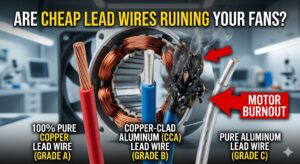
A detailed educational infographic comparison image with a large headline at the top asking: "ARE CHEAP LEAD Wires RUINING YOUR FANS?" Below the headline is an illustration of a disassembled fan motor with visible copper coils and three distinct types of cut-away lead wires fanning out. From left to right: a red insulated wire stripped to reveal multiple strands of pure copper, with a label reading: "100% PURE COPPER LEAD WIRE (GRADE A)"; a blue insulated wire showing a single thick silver-colored metal core with a thin outer copper layer, labeled: "COPPER-CLAD ALUMINUM (CCA) LEAD WIRE (GRADE B)"; and a gray insulated wire with a single thick silver-colored metal core, labeled: "PURE ALUMINUM LEAD WIRE (GRADE C)". Two red arrows point to a charred and damaged section of the CCA and aluminum wires, with a red text box pointing to the area reading: "MOTOR BURNOUT". The background shows a blurred professional laboratory or workshop setting with equipment and a fully assembled fan, reinforcing the context. The overall image visually contrasts Grade A pure copper wiring with Grade B (CCA) and Grade C (aluminum) wiring, suggesting that using cheaper alternatives leads to motor failure and burnout.
April 8, 2026

Are Cheap Lead Wires Ruining Your Fans?

Busy season ended, but returns are piling up. Customers complain about dead motors and smoke. The cause? It is often just a…

Read More…

A detailed photograph comparing two types of bearings on a desk, designed for an OEM (Original Equipment Manufacturer) decision-making context. In the center-left, a cylindrical brass-colored sleeve bearing is labeled 'SLEEVE (Oil-lubricated)' with short stacks of coins in front. To its right, an open silver ball bearing showing internal steel balls is labeled 'BALL (rolling)' with significantly taller stacks of coins in front, indicating a higher initial cost. Below the physical objects are clear bar charts. The chart for 'Sleeve' shows a shorter bar for 'INITIAL COST' and a bar reaching about 50 for 'LIFESPAN'. The chart for 'Ball' shows a longer bar for 'INITIAL COST' and a bar reaching 100 for 'LIFESPAN'. In the background, a person holds a tablet with a complex chart titled 'OEM BUDGET CHOICE' and 'ROI' (Return on Investment). A whiteboard with mechanical blueprints and computer monitors with other charts are visible, reinforcing an engineering office environment. The image visually guides a manufacturer on the cost versus long-term value trade-offs.
March 29, 2026

Sleeve vs. Ball Bearing: Which Suits Your OEM Budget?

For an OEM electric fan project, the bearing inside the motor may look like a minor component. In reality, it can influence…
Read More…

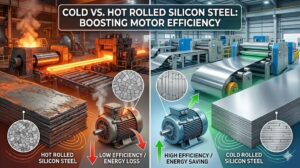
A high-resolution comparative infographic and photographic image showing how hot-rolled and cold-rolled silicon steel affect electric motor efficiency. The top central title states: "COLD VS. HOT ROLLED SILICON STEEL: BOOSTING MOTOR EFFICIENCY". The image is vertically split. The left section, with warm orange and red tones representing heat and energy loss, is dedicated to "HOT ROLLED SILICON STEEL". At the top, a rugged steel mill is producing glowing red-hot metal with large rolling machines and heat. Below, a close-up shows a stack of rough-textured, dark hot-rolled steel sheets. A magnified inset circle displays a disorganized, random grain structure. Further below, a schematic inset shows turbulent, inefficient magnetic flux lines. At the bottom center, an old, overheating motor is pictured with a downward-pointing red arrow and the text "LOW EFFICIENCY / ENERGY LOSS". The right section, with cool blue and green tones representing controlled temperature and efficiency, is dedicated to "COLD ROLLED SILICON STEEL". At the top, a clean, modern facility uses advanced automated machinery for cold-rolling silver metal sheets. Below, a close-up shows a stack of smooth, reflective, light-colored cold-rolled steel sheets. A magnified inset circle displays a perfectly aligned, neat, oriented grain structure (取向硅钢). Further below, a schematic inset shows smooth, efficient magnetic flux lines. At the bottom center, a clean, modern motor runs smoothly with an upward-pointing green arrow and the text "HIGH EFFICIENCY / ENERGY SAVING".

Cold vs. Hot Rolled Silicon Steel: Which Boosts Motor Efficiency?

High energy bills and poor motor performance can hurt your business. Are you using the wrong materials? The steel inside your motor…

Read More…

A detailed product comparison photograph on a brushed metal workbench. At the top, bold white and yellow text poses the question: "WHICH STATOR LASTS LONGER? 71x16mm vs. 66x14mm FAN MOTOR COMPARISON." Arrows point from the text to two unmounted AC fan motor stators below, shown side-by-side. On the left, the stator labeled "66x14mm" is noticeably shorter and has a smaller circumference. It features a ring of thin copper wire windings that are flatter and more open. On the right, the stator labeled "71x16mm" is significantly taller and has a larger diameter, constructed with more steel laminations and features thicker, more voluminous, and much denser copper wire windings, suggesting more power and durability. The visual difference in size and copper wire amount is distinct.
March 26, 2026

71x16mm vs. 66x14mm: Which Stator Size Lasts Longer?

Fans break down fast. A dead fan means hot rooms and lost money. The fix is inside the motor. You must check…

Read More…

A detailed close-up photograph of a small electric fan actively smoking and overheating on a cluttered electronics repair workbench. The metal motor housing is melted and charred, revealing glowing orange-red coils inside a burnt hole. White smoke is billowing upwards from the damaged area. A digital temperature probe is inserted into the motor casing, with the thermometer displaying a dangerous "TEMP: 138.5°C". The background shows a variety of tools, wires, and electronic components.

Why Do Cheap Fan Motors Overheat After 4 Hours?

Is your new fan too hot to touch? You buy a cheap fan, and it smells like burning plastic. It is scary…

Read More…

A split-screen infographic comparing two industrial electric motors, titled "COPPER vs CCA: HOW TO TEST MOTOR QUALITY" at the top in large white text against a blurred workshop background. On the left, an open motor with reddish-brown coils is labeled "PURE COPPER". A digital multimeter reads "0.2 Ω" and a digital scale shows "1.2 kg", with text "HEAVIER WEIGHT, LOW RESISTANCE" below. On the right, an identical open motor labeled "CCA (FAKE COPPER)" shows windings with silver-white metal exposed beneath the outer copper coating where insulation has been peeled back. A piece of stripped wire with a silver end lies in the foreground with an arrow from "SCRAPING A CORE" pointing to the motor. A digital scale reads "0.4 kg" and a digital multimeter reads "0.6 Ω", with text "LIGHTER WEIGHT, HIGH RESISTANCE" below. Both sides feature other lab equipment and toolboards in an industrial workshop setting. A scraping tool lies on the bench in the center foreground.
March 24, 2026

Copper vs CCA: How to Test Motor Quality?

Worried your new motor is fake? Fake copper causes burnouts and lost money. Let’s fix that. Here is how to test your…

Read More…

Seraphinite AcceleratorOptimized by Seraphinite Accelerator
Turns on site high speed to be attractive for people and search engines.