

Drum Fan vs Pedestal Fan vs Blower Fan: Which One Should You Choose?
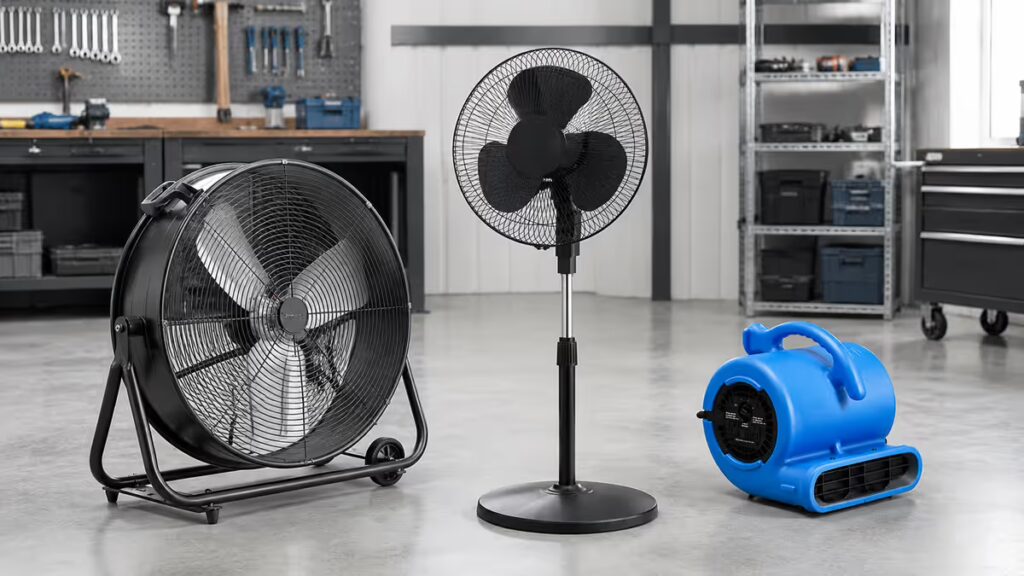
Table of Contents
Choosing the right fan is not simply a matter of finding the model with the highest airflow rating. A drum fan, pedestal fan, and blower fan are designed for different jobs. One may be ideal for cooling people in a workshop, while another is better for moving air through a large warehouse or drying a wet carpet.
The best choice depends on what you need to cool, dry, ventilate, or move.
This guide explains the differences between drum fans, pedestal fans, and blower fans, including their airflow, pressure, noise, energy use, portability, and ideal applications.

Quick Answer
- Choose a pedestal fan for cooling people in bedrooms, offices, stores, and living spaces.
- Choose a drum fan for moving large amounts of air across warehouses, workshops, garages, and other open areas.
- Choose a blower fan or air mover for drying carpets, floors, paint, equipment, and concentrated areas.
- Choose a centrifugal blower when air must pass through ducts, filters, narrow openings, or other forms of resistance.
The strongest fan is not always the best fan. The right product is the one that matches your application.
What Is a Drum Fan?

A drum fan is a large, high-velocity fan enclosed in a cylindrical housing. It is also commonly called a barrel fan, industrial drum fan, or high-velocity industrial fan.
Most drum fans use an axial fan design. The blades move air in a straight line through the cylindrical housing. This allows the fan to move a large volume of air across an open space.
Drum fans are commonly used in:
- Warehouses
- Workshops
- Garages
- Factories
- Agricultural buildings
- Construction sites
- Outdoor events
- Large commercial spaces
Many drum fans include wheels, handles, adjustable airflow angles, and protective grills. Their design makes them easier to move than permanently installed industrial ventilation equipment.
Advantages of a Drum Fan
- High airflow for large open areas
- Long air throw compared with ordinary household fans
- Rugged construction
- Easy to move around a workshop or warehouse
- Effective for general ventilation and heat relief
- Available in several sizes and motor powers
Limitations of a Drum Fan
- Can be noisy at high speed
- Usually consumes more electricity than a small household fan
- May not provide enough static pressure for ducts or restrictive filters
- Often lacks the precise directional airflow of a blower
- May be too powerful or noisy for bedrooms and quiet offices
A drum fan is generally best when the goal is to circulate air across a large, relatively open area.
What Is a Pedestal Fan?

A pedestal fan is a standing fan mounted on an adjustable pole and a stable base. It is also called a stand fan, standing fan, or oscillating fan.
Pedestal fans are designed primarily to improve human comfort. They usually include oscillation, multiple speed settings, height adjustment, and sometimes a remote control or timer.
They are commonly used in:
- Bedrooms
- Offices
- Living rooms
- Restaurants
- Retail stores
- Classrooms
- Small workshops
- Indoor events
Pedestal fans normally produce a broad and relatively comfortable airflow. Their oscillating movement helps distribute air over a wider area instead of directing it continuously at one point.
Advantages of a Pedestal Fan
- Comfortable airflow for people
- Adjustable height and direction
- Oscillation improves air distribution
- Usually quieter than industrial drum fans
- Suitable for long periods of personal use
- Often affordable and easy to clean
- Available with remote controls and timers
Limitations of a Pedestal Fan
- Less effective in very large spaces
- Usually has a shorter air throw
- Not designed for drying carpets or wet floors
- Limited ability to overcome air resistance
- Less durable than heavy-duty industrial models in harsh environments
A pedestal fan is usually the most practical option when the main purpose is to cool people rather than dry materials or ventilate a large industrial space.
What Is a Blower Fan?

“Blower fan” is a broad term that can describe several different types of equipment. Depending on the market, it may refer to an air mover, centrifugal blower, industrial blower, floor blower, or even a powerful handheld air blower.
Unlike a typical axial fan, many blower fans use centrifugal airflow. Air enters the housing and is redirected through an outlet. This design can produce a more concentrated airflow and, in many cases, higher static pressure.
Blower fans and air movers are commonly used for:
- Drying carpets and floors
- Water damage restoration
- Drying paint and construction materials
- Ventilating confined areas
- Cooling machinery and electrical equipment
- Moving air through short ducts
- Drying vehicles and interiors
- Localized ventilation
A blower fan is generally designed to direct air at a specific area rather than circulate air throughout an entire room.
Advantages of a Blower Fan
- Fast, concentrated airflow
- Useful for drying wet surfaces and materials
- Often produces higher static pressure
- Can be positioned at several angles
- Effective in confined or targeted areas
- Many models can run continuously
- Compact air movers are often stackable and easy to transport
Limitations of a Blower Fan
- May not cool people comfortably
- Often produces a narrow airflow pattern
- Can be noisy
- May not circulate air evenly throughout a large room
- Performance varies significantly between models
- The term “blower” can cause confusion when shopping
When buying a blower fan, check whether the product is designed for drying, ventilation, ducting, equipment cooling, or general air movement. These applications may require very different specifications.
Drum Fan vs Pedestal Fan vs Blower Fan: Comparison
| Feature | Drum Fan | Pedestal Fan | Blower Fan / Air Mover |
|---|---|---|---|
| Primary purpose | Move air across large spaces | Cool people comfortably | Dry or direct air at a specific area |
| Airflow pattern | Broad and long-range | Broad and oscillating | Concentrated and directional |
| Typical airflow | High | Low to medium | Medium to high |
| Air velocity | High | Medium | High to very high |
| Static pressure | Low to medium, depending on model | Usually low | Medium to high, depending on model |
| Best environment | Warehouse, workshop, garage | Home, office, store | Carpet, floor, equipment, construction site |
| Oscillation | Usually limited or unavailable | Common | Usually unavailable |
| Noise level | Medium to high | Low to medium | Medium to high |
| Portability | Good, often with wheels | Good, but less rugged | Very good |
| Drying performance | Moderate | Limited | Excellent for targeted drying |
| Comfort for people | Moderate | Excellent | Limited |
| Typical construction | Heavy-duty cylindrical housing | Lightweight stand and base | Compact housing with focused outlet |
Actual performance depends on the motor, blade design, housing, outlet size, speed settings, and manufacturer specifications. The table provides a general comparison rather than a guarantee for every model.
Airflow, Air Velocity, and Static Pressure Explained

Many buying guides focus only on airflow. That can be misleading because airflow, air velocity, and static pressure describe different aspects of fan performance.
Airflow
Airflow is the amount of air a fan moves over a given period. It may be measured in:
- CFM, or cubic feet per minute
- m³/h, or cubic meters per hour
- L/s, or liters per second
High airflow is useful when you need to circulate air throughout a large open space.
Air Velocity
Air velocity describes how fast the air is moving at a particular point. A fan may have a smaller total airflow but a very high outlet velocity.
High air velocity is useful for:
- Drying wet floors
- Drying carpets
- Removing heat from equipment
- Directing air into a specific area
Static Pressure
Static pressure measures a fan’s ability to maintain airflow against resistance. Resistance may come from:
- Ducts
- Filters
- Vents
- Narrow openings
- Wet materials
- Equipment enclosures
A blower or centrifugal fan is usually more suitable than a standard pedestal fan when static pressure is important.
Air Throw
Air throw refers to how far the airflow can travel before losing most of its useful force. Drum fans are often chosen for their long air throw in open spaces, while blower fans create a stronger but more localized stream.
Which Fan Is Best for Cooling People?
For personal cooling, a pedestal fan is usually the best choice.
A pedestal fan can be adjusted to the user’s height and direction. Its oscillation function helps distribute air around a room, and its broader airflow is generally more comfortable for long periods.
A drum fan may also cool people effectively in a workshop or garage, especially when the area is hot and spacious. However, it may be louder and less comfortable at close range.
A blower fan is usually not the first choice for personal cooling because its airflow is too concentrated. It may feel uncomfortable when aimed directly at the face or body.
Best choice for personal cooling
Pedestal fan
Consider a drum fan when:
- The space is large and open
- You need longer air throw
- Noise is acceptable
- You want heavy-duty construction
Which Fan Is Best for a Warehouse or Workshop?
A drum fan is often the best choice for a warehouse, workshop, garage, or factory floor.
Its cylindrical housing and powerful motor allow it to move a large volume of air over a considerable distance. Models with wheels can be repositioned as work areas change.
However, a drum fan is not always the right answer. If the space contains ducts, exhaust systems, or restrictive filters, a centrifugal blower or dedicated ventilation fan may perform better.
Best choice for large open areas
Drum fan
Consider a blower when:
- Air must be directed through a duct
- You need higher static pressure
- The airflow must reach a narrow or enclosed area
- You are ventilating equipment rather than people
Which Fan Is Best for Drying Carpets and Floors?
A blower fan or air mover is generally the best option for drying carpets, floors, upholstery, and other wet surfaces.
Air movers are designed to direct high-velocity air close to the surface. This helps increase evaporation and reduce drying time.
Useful features include:
- Multiple adjustable outlet angles
- High outlet velocity
- Continuous-duty motor
- Stackable housing
- Moisture-resistant construction
- Low-profile design
- Built-in power outlets for connecting multiple units
A drum fan can help with general ventilation, but it usually does not direct air as effectively across a wet carpet or floor. A pedestal fan is usually too weak and too diffuse for professional drying work.
Best choice for targeted drying
Blower fan or air mover
Which Fan Uses Less Electricity?
Energy consumption depends on the motor rating and the number of hours the fan operates. A simple calculation can help estimate running costs:
Daily energy use (kWh) =
Power rating (W) ÷ 1,000 × Operating hours per day
For example, a 500-watt fan running for eight hours would use:
500 ÷ 1,000 × 8 = 4 kWhEstimated electricity cost can be calculated as:
Electricity cost =
Daily energy use × Local electricity price per kWh
A smaller pedestal fan will often use less electricity than a large drum fan. However, a more powerful fan may complete a cooling or drying task faster. The lowest wattage does not automatically mean the lowest total operating cost.
When comparing models, consider:
- Motor power
- Airflow
- Air velocity
- Operating time
- Coverage area
- Required drying time
- Local electricity rates
Noise Considerations
Noise is especially important in bedrooms, offices, classrooms, and retail environments.
Pedestal fans are generally the quietest option for everyday personal cooling, although noise levels vary by motor and speed setting.
Drum fans and blower fans usually produce more noise because they are designed for higher airflow or higher air velocity. They may be appropriate for workshops and warehouses but less suitable for quiet indoor spaces.
Look for a manufacturer-rated sound level in dB(A). Remember that:
- Higher speed usually means more noise
- Larger motors are not always quieter
- Housing and blade design affect sound
- Distance from the fan changes perceived loudness
- A fan with a lower dB rating may move less air
If the fan will operate near people for many hours, noise should be treated as a primary specification rather than an afterthought.
Safety and Maintenance
All three fan types require basic safety precautions.
Before using a fan, check:
- Whether the protective grill is securely installed
- Whether the power cord is undamaged
- Whether the fan is placed on a stable surface
- Whether the motor has overheating protection
- Whether the product is suitable for the local voltage
- Whether the unit is rated for damp or wet environments
- Whether the fan has proper grounding where required
Always disconnect the power before cleaning or servicing the fan. Keep fingers, clothing, cables, and loose materials away from the blades and air intake.
For industrial applications, also check:
- IP rating
- Continuous-duty rating
- Electrical certification
- Dust resistance
- Wheel locks
- Tip-over protection
- Availability of replacement parts
- Warranty and local service support
A fan that is suitable for a dry workshop may not be suitable for a wet restoration site.
How to Choose the Right Fan
Use the following decision guide:
Choose a pedestal fan if:
- You want to cool people
- You need oscillation
- The fan will be used in a bedroom or office
- Low or moderate noise is important
- You want adjustable height
- You need a simple, affordable solution
Choose a drum fan if:
- You need to ventilate a large open area
- You want high airflow and long air throw
- The fan will be used in a warehouse or workshop
- You need a rugged, mobile unit
- Moderate or high noise is acceptable
- You want to move air across a wide area
Choose a blower fan or air mover if:
- You need to dry carpets or floors
- You are dealing with water damage
- You need concentrated airflow
- You want to cool machinery or equipment
- You need multiple positioning angles
- You require continuous-duty operation
Choose a centrifugal blower if:
- Air must pass through ducts or filters
- Static pressure is more important than open-air coverage
- You need focused airflow in a confined space
- You are working with professional ventilation equipment
Frequently Asked Questions
Is a drum fan stronger than a pedestal fan?
In terms of airflow and air throw, a drum fan is usually stronger. It is designed for larger spaces and more demanding environments. A pedestal fan, however, is often more comfortable for personal cooling because it oscillates and distributes air more gently.
Is a blower fan the same as a drum fan?
No. A drum fan usually moves a large volume of air through an open space. A blower fan usually produces more concentrated airflow and may provide higher static pressure. The exact difference depends on the product design.
Can I use a drum fan to dry a carpet?
You can use a drum fan to improve general ventilation, but a dedicated air mover or blower fan is usually more effective for carpet drying. Air movers are designed to direct air close to the surface.
Is a blower fan good for cooling a room?
A blower fan can move air, but it is not always ideal for cooling an entire room. Its airflow is usually more concentrated. A pedestal fan or drum fan may provide more even air circulation.
Which fan is best for a garage?
For a small garage, a pedestal fan may be sufficient. For a large or hot garage, a drum fan can provide stronger air circulation. If you need to dry a wet floor or direct air into a specific area, choose a blower or air mover.
What is more important: airflow or air velocity?
It depends on the task. Airflow is more important for ventilating large open areas. Air velocity is more important for targeted drying, equipment cooling, and localized air movement. Static pressure becomes important when air must overcome resistance.
Does a higher wattage fan always perform better?
No. Higher wattage does not automatically mean better performance. Compare the motor power with airflow, air velocity, static pressure, noise, and coverage area.
Final Verdict
There is no single winner between a drum fan, pedestal fan, and blower fan. Each type is designed for a different job.
- For comfortable personal cooling, choose a pedestal fan.
- For high-volume airflow in warehouses, workshops, and garages, choose a drum fan.
- For drying carpets, floors, paint, and equipment, choose a blower fan or air mover.
- For ducts, filters, and restricted airflow paths, choose a centrifugal blower.
The best buying decision comes from matching the fan to the application—not simply choosing the model with the highest airflow number.
Before purchasing, compare airflow, air velocity, static pressure, noise, power consumption, portability, safety features, and local voltage requirements. A fan that is powerful in one situation may be inefficient or uncomfortable in another.

Mike Chung
Read all articlesYou May Also Like
More practical guides for electric fan importers, distributors and brand owners.


