
Ceiling Fan vs Wall Fan: Which One Is Better for Your Room?
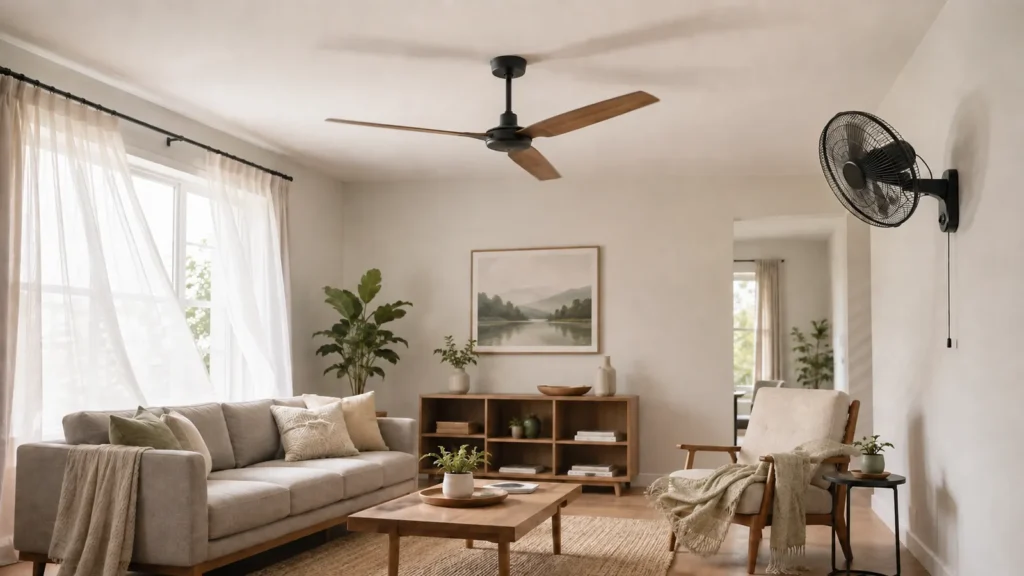
Table of Contents
A ceiling fan and a wall fan can both make a room feel cooler. But they move air in different ways. A ceiling fan is usually better for wide and even airflow. A wall fan is better when you want strong air in one part of a room.
The right choice depends on your room size, ceiling height, layout, noise needs, and installation limits. Power use matters too. But you should compare actual fan models instead of judging by fan type alone.
Quick Answer: Ceiling Fan or Wall Fan?
Choose a ceiling fan when you want steady airflow across most of the room. Choose a wall fan when you want to direct the air toward a bed, desk, counter, machine, or work area.
[Image placeholder: A ceiling fan and a wall-mounted fan operating in the same room, showing wide airflow and focused airflow]
The two fans do not do the same job. A ceiling fan is designed for whole-room air circulation. A wall fan is designed for focused and directional airflow.
| Need or room condition | Better choice |
|---|---|
| Wide airflow for several people | Ceiling fan |
| Strong air aimed at one area | Wall fan |
| Low ceiling | Wall fan |
| No free wall space | Ceiling fan |
| Bunk bed below the fan | Wall fan |
| Desk, counter, or fixed workstation | Wall fan |
| Large bedroom or living room | Ceiling fan |
| Workshop or narrow commercial space | Wall fan or a mixed system |
| Airflow plus a ceiling light | Ceiling fan with light |
| Easy access for cleaning | Wall fan |
Choose a ceiling fan when:
- The fan can be placed near the center of the room.
- The ceiling has enough height and structural support.
- Several people need airflow at the same time.
- You want to keep walls and floors clear.
- You want soft and steady airflow.
Choose a wall fan when:
- The ceiling is too low or cannot support a fan.
- You need air in one clear direction.
- The room has a bunk bed or tall furniture.
- You need airflow over a desk, counter, or work zone.
- You want a fan that is easier to reach for cleaning.
Airflow and Cooling
A ceiling fan usually moves air through a large part of the room. A wall fan sends air outward from one side. Many wall fans can also move from side to side. This spreads the air across a wider angle, but the airflow is still more focused than ceiling-fan airflow.
[Image placeholder: Simple airflow diagram comparing downward whole-room circulation from a ceiling fan with directional airflow from a wall fan]
A ceiling fan pushes air down and outward. The air then moves across the room and rises again near the walls. This creates a broad circulation pattern.
A wall fan sends air forward. The strongest airflow is usually close to the center of its air path. The effect becomes weaker as the distance grows.
Does a fan lower room temperature?
A fan normally does not lower the air temperature in a room. It makes people feel cooler by moving air over the skin. This helps body heat and sweat leave the skin faster.
This means:
- A fan should usually be turned off when nobody is in the room.
- A fan is not the same as an air conditioner.
- A comfort fan does not remove humidity.
- A comfort fan does not remove smoke, oil, dust, or dirty air.
- A fan can help an air conditioner work more comfortably, but it does not replace it.
Whole-room airflow vs focused airflow
| Airflow factor | Ceiling fan | Wall fan |
|---|---|---|
| Main airflow pattern | Wide and circular | Forward and directional |
| Best for | Several people | One zone or a few people |
| Air feeling | Soft and even | Direct and stronger |
| Direction control | Limited | Usually adjustable |
| Side-to-side movement | No | Often available |
| Effect at long distance | Broad but less direct | Strong on path, weaker outside it |
Room Size, Layout, and Ceiling Height
Room size matters, but it is not the only factor. You should also look at where people sit, where furniture stands, and whether the ceiling or wall can hold the fan safely.
[Image placeholder: Room plan showing a centered ceiling fan, a wall fan above a desk, furniture, and clear safety zones]
A ceiling fan works best when it can sit near the middle of the occupied area. A wall fan works best when it has a clear path toward the people or area that needs air.
Ceiling height and clearance
The fan blades must stay safely above people, beds, shelves, and other objects. In general, ceiling-fan blades should be at least 7 feet, or about 2.1 metres, above the floor. A height of about 8 to 9 feet, or 2.4 to 2.7 metres, can provide better airflow when the room allows it.
The fan should also have enough space from walls and furniture. Always follow local rules and the instructions for the exact model.
A low-profile ceiling fan may fit a low ceiling. But blades that sit very close to the ceiling may move less air.
Layout questions to ask
Before choosing a fan, answer these questions:
- How large is the room?
- How high is the ceiling?
- Where do people spend the most time?
- Is there a bunk bed or tall cabinet?
- Is the ceiling strong enough for a moving load?
- Is there a safe and strong wall for a wall fan?
- Will the airflow hit papers, food, screens, or light objects?
- Is the fan for indoor, damp, or outdoor use?
Power Use and Energy Efficiency
Neither fan type is always more energy efficient. A small wall fan may use less power than a large ceiling fan. But one ceiling fan may cover an area that would need two or more wall fans.
[Image placeholder: Electricity meter beside two fan specification labels showing watts, airflow, operating hours, and cost]
The simplest way to estimate energy use is:
Energy use in kWh = Power in watts ÷ 1,000 × Hours used
For example, a 50-watt fan used for eight hours consumes:
50 ÷ 1,000 × 8 = 0.4 kWh
Multiply the result by your local electricity rate to estimate the cost.
Do not compare watts alone
Watts show how much electrical power a fan uses. They do not show how much useful air the fan moves.
A better comparison includes:
| Measurement | What it tells you |
|---|---|
| Watts | Electrical input |
| CFM or m³/h | Amount of air moved |
| CFM/W | Airflow for each watt |
| Fan diameter | Possible coverage area |
| Speed setting | Operating level used in the test |
| Number of fans | Total units needed for the space |
| Daily running time | Real energy use |
| Standby power | Power used by electronic controls when idle |
A fair energy comparison
Compare fans under the same conditions:
- Use the same speed setting or similar comfort level.
- Compare the same room and occupied area.
- Include every fan needed for that area.
- Keep fan lights separate from motor power.
- Check standby power for remote or smart controls.
- Use tested airflow data when it is available.
Noise and Sleep Comfort
A ceiling fan often feels quieter because it is farther from the listener and usually produces broad airflow at a lower speed. A wall fan may be closer to the bed or desk. Its guard, motor, airflow, and moving head may be easier to hear.
[Image placeholder: Quiet bedroom with a ceiling fan and a wall fan, plus a sound meter placed at pillow height]
Still, fan type alone does not decide noise. A well-made wall fan may be quieter than a poorly installed ceiling fan.
What creates fan noise?
Common noise sources include:
- Motor vibration
- Worn bearings
- Unbalanced blades
- Loose screws
- A weak mounting surface
- Guard vibration
- Fast airflow through the grille
- A wall fan’s side-to-side motor
- A ceiling fan that is not level
How to compare noise correctly
Look for a noise level in dB(A). Also check:
- The speed used during the test
- The distance between the fan and the meter
- The room’s background noise
- Whether the fan was fixed to a solid surface
- Whether the result covers every speed
For a bedroom, low-speed noise is often more important than maximum-speed noise.
Installation and Safety
A ceiling fan usually needs more installation work. It must be fixed to a ceiling point that can support its weight and movement. A wall fan also needs a strong mounting surface, but it is often easier to add to an existing room.
[Image placeholder: Installer checking a ceiling support box and a wall bracket with safety clearance marks]
Electrical and structural work should follow local rules. A ceiling light box is not always strong enough for a ceiling fan. A wall surface may also be unsafe if it is weak, hollow, or damaged.
Ceiling-fan installation checks
- Confirm that the mounting point is rated for a fan.
- Check blade height above the floor.
- Leave enough space from walls and furniture.
- Use the correct downrod or low-profile mount.
- Check that the blades are balanced.
- Use a damp-rated or wet-rated model where needed.
- Do not place the fan above an unsafe bed or bunk-bed area.
Wall-fan installation checks
- Fix the bracket to a strong wall or solid support.
- Keep the guard away from hands and loose objects.
- Aim the fan at the occupied area.
- Leave room for side-to-side movement.
- Keep the power cable away from hot or wet areas.
- Make sure the fan can be reached safely for cleaning.
- Use the correct protection rating for damp, dusty, or outdoor areas.
Best Fan for Different Rooms
The same fan type will not be best in every room. The best choice depends on the people, furniture, heat sources, and airflow target.
[Image placeholder: Grid showing fan use in a bedroom, living room, kitchen, classroom, shop, workshop, and covered patio]
Use the table below as a starting point. Then check the exact fan size, airflow, power, and installation rules.
| Room or use case | Suggested choice | Main reason |
|---|---|---|
| Large bedroom | Ceiling fan | Wide, soft airflow |
| Small bedroom with low ceiling | Wall fan | Safer use of overhead space |
| Room with a bunk bed | Wall fan | Avoids overhead blade risk |
| Living room | Ceiling fan | Shared airflow for several people |
| Home office | Wall fan | Can aim air at the desk |
| Dining room | Ceiling fan | Broad airflow with less direct blast |
| Kitchen work zone | Wall fan | Focused airflow, if suitable for the area |
| Shop counter | Wall fan | Direct air for staff |
| Classroom | Ceiling fan or mixed system | Wide coverage with local support |
| Workshop | Wall fan | Strong airflow toward work areas |
| Warehouse | Engineered ceiling or mixed system | Layout and height need a site plan |
| Covered patio | Properly rated ceiling or wall fan | Choice depends on layout and water exposure |
Kitchens and industrial spaces need extra care
A comfort fan does not replace an exhaust fan. It cannot safely remove cooking fumes, oil, heat, dust, or harmful gases.
Commercial kitchens, dusty workshops, and other controlled spaces may have special rules. Airflow can spread smoke or particles. A qualified local professional should review the site before installation.
Cleaning and Maintenance
Wall fans are often easier to clean because the grille and blades are closer to the user. Ceiling fans can take longer to reach, but their open blade design may be simpler to wipe.
[Image placeholder: Side-by-side cleaning steps for a wall fan grille and ceiling fan blades]
Turn off the power before cleaning or checking either fan. Do not work on a fan while its blades can move.
Basic maintenance checklist
| Task | Ceiling fan | Wall fan |
|---|---|---|
| Clean blade dust | Regularly | Regularly |
| Clean grille | Usually not present | Important |
| Check mounting screws | Important | Important |
| Check blade balance | Important | Check for damage |
| Check side-to-side movement | Not needed | Important |
| Listen for bearing noise | Important | Important |
| Inspect cable and controls | Important | Important |
| Check outdoor corrosion | For rated outdoor models | For rated outdoor models |
A dirty grille can reduce a wall fan’s airflow. Heavy dust on ceiling-fan blades can affect balance. Loose parts can add noise and vibration.
Can You Use Both Fans Together?
Yes. A ceiling fan and a wall fan can work together when a room has both a general airflow need and a clear hot spot.
[Image placeholder: Large room using a ceiling fan for general circulation and a wall fan aimed at a work area]
A mixed system can be useful in classrooms, restaurants, workshops, gyms, and long rooms. The ceiling fan keeps air moving across the wider space. The wall fan adds stronger airflow where people work or sit.
When a mixed system makes sense
Use both types when:
- One ceiling fan cannot reach a side area.
- A room has several fixed work zones.
- Heat enters from one wall or doorway.
- Some people want stronger airflow than others.
- The room is long, divided, or partly blocked.
Do not add more fans without a plan. Fans can work against each other if their airflow paths conflict. Test the fan directions and speed settings after installation.
Conclusion
A ceiling fan is usually the better choice for broad and even airflow across a room. A wall fan is usually better for focused airflow, low ceilings, tight layouts, and fixed work areas.
[Image placeholder: Final decision tree showing whole-room airflow leading to a ceiling fan and focused airflow leading to a wall fan]
There is no universal winner. Start with the job the fan must do. Then check the room, ceiling height, mounting surface, airflow, watts, noise, safety rating, and maintenance needs.
For a fair product comparison, use model-level data. Compare airflow, power, airflow per watt, noise at each speed, installation limits, and total units needed. This gives a much more useful answer than comparing fan types by name alone.