
3-Blade vs 5-Blade Fans: Airflow, Noise and Efficiency Explained
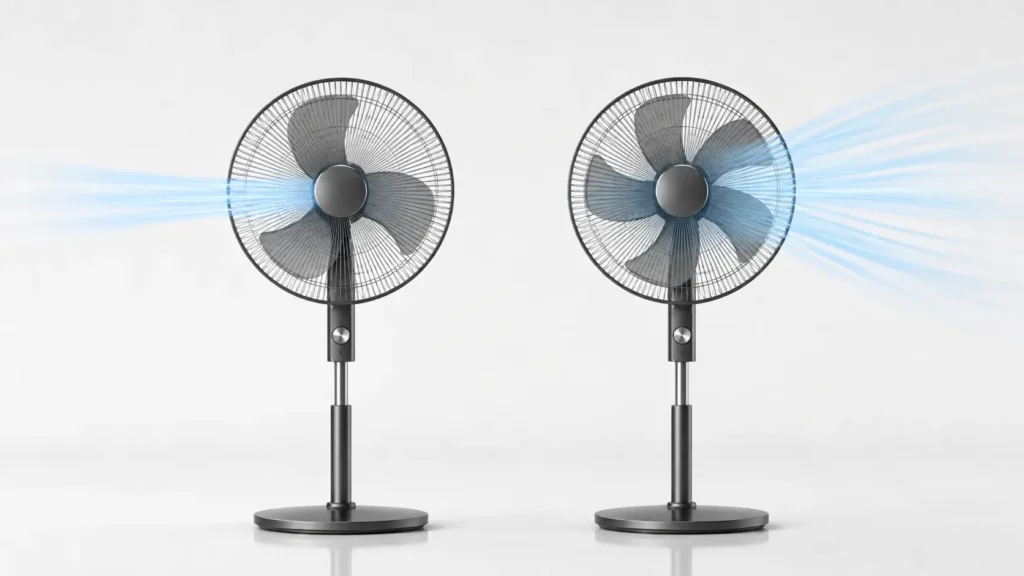
Table of Contents
Is a 3-blade fan better than a 5-blade fan? There is no fixed answer. A 3-blade fan often has less drag. It may spin faster and create a stronger, more direct breeze. A 5-blade fan often spreads air more evenly. Its airflow may also feel smoother.
But blade count alone does not tell you which fan moves more air, makes less noise, or uses less power.
The full fan design matters. This includes blade size, blade shape, blade angle, motor power, speed, fan diameter, and the grille. The type of fan matters too. A ceiling fan works in a different way from a pedestal fan.
3-Blade vs 5-Blade Fans at a Glance
The table below shows common design trends. These are not rules for every fan. Two fans can give very different results even when they have the same number of blades.
| Feature | 3-Blade Fan | 5-Blade Fan |
|---|---|---|
| Air resistance | Often lower | Often higher |
| Motor load | Often lower | Often higher |
| Common airflow feel | Direct and focused | Smooth and even |
| Speed | Often easier to run at high RPM | May need more motor torque |
| Total airflow | Depends on the full design | Depends on the full design |
| Noise | Can be quiet or loud | Can be quiet or loud |
| Energy use | Often has an efficiency advantage | Depends on motor matching |
| Weight | Often lower | Often higher |
| Cleaning | Fewer blade surfaces | More blade surfaces |
| Common style | Simple and modern | Full and traditional |
The short answer is simple: choose a 3-blade fan when you want a direct breeze, a light design, and good efficiency. Choose a 5-blade fan when you want smooth airflow and wide coverage. Still, check the measured airflow, noise, and power before you buy.
How Blade Count Changes Airflow
A fan blade pushes air as it turns. More blades give the fan more blade surface. This may sound like a clear reason for a 5-blade fan to move more air. But each extra blade also creates more resistance. It also moves through air disturbed by the blade in front of it.
The motor must overcome this extra load. If the motor is not strong enough, the fan may run at a lower speed. The extra blade area may then give little or no gain in total airflow.
Blade Area and Drag
Fan engineers use the term solidity. This means how much of the turning circle is covered by blades. A 5-blade fan often has higher solidity than a similar 3-blade fan.
Higher solidity can help a fan push more air at a lower speed. But it can also cause:
- More air resistance
- More motor load
- More disturbed air between the blades
- More weight and turning force
- A lower final speed when the motor is not matched well
A 3-blade fan often has more open space between its blades. This can reduce drag. It may let the motor reach a higher RPM. The result can be a fast and focused stream of air.
Airflow Is Not the Same as Air Speed
People often say that one fan gives “more air.” That phrase can mean several different things.
| Term | What It Means | Why It Matters |
|---|---|---|
| Airflow | The total amount of air moved over time | Shows how much air the fan can circulate |
| Air speed | How fast the air moves at one point | Changes how strong the breeze feels |
| Air throw | How far useful airflow travels | Important in long rooms and work areas |
| Air spread | How wide the airflow pattern is | Important when covering more people or space |
A 3-blade fan may produce higher air speed near the center. A 5-blade fan may spread air across a wider area. The first fan may feel stronger at one spot. The second may move a similar total amount of air across a wider zone.
This is why a hand test is not enough. It only tells you how the air feels at one place. It does not measure total airflow.
Blade Shape and Angle Matter
Blade count is only one part of the fan. Blade shape and blade angle can make a larger difference.
A wide blade at a strong angle can move a lot of air. But it also needs more motor torque. A narrow blade at a small angle creates less load. But it may move less air at the same speed.
Important blade details include:
- Blade pitch: the angle at which the blade meets the air
- Blade width: how much blade surface pushes the air
- Blade curve: how the blade guides air across its surface
- Blade length: how far the blade reaches from the center
- Tip shape: how the outer edge controls drag and noise
You cannot compare blade count fairly when these details are very different.
Are 5-Blade Fans Quieter?
A 5-blade fan is often sold as the quieter choice. This can be true for some products. It is not a rule.
More blades may create smaller and more frequent air pulses. The breeze may feel smoother. The sound may also seem less rough. But smoother sound does not always mean lower noise.
What Creates Fan Noise?
Fan noise comes from more than the blades. A fan can make noise in several ways.
| Noise Source | Common Cause | What You May Hear |
|---|---|---|
| Blade noise | High tip speed, poor blade shape, or uneven airflow | Rushing or chopping air |
| Motor noise | Motor design or electronic control | Hum, buzz, or a high tone |
| Bearing noise | Wear, poor fit, or low-quality parts | Rattle, grind, or click |
| Grille noise | Blade wake passing close to grille wires | Repeated tone or hiss |
| Structure noise | Loose parts or vibration | Buzzing or shaking |
| Installation noise | Loose ceiling mount, stand, or base | Rattle or low vibration |
A 3-blade fan can be very quiet when it uses a good motor and well-shaped blades. A 5-blade fan can be loud when its motor is weak or its parts vibrate.
Blade-Passing Frequency
Each blade creates a small pressure pulse as it passes a fixed point. A 5-blade fan creates more pulses per turn than a 3-blade fan. This is called the blade-passing frequency.
More frequent pulses can make the sound feel smoother. But they can also create a clear tone at a higher frequency. The final result depends on RPM, blade shape, the grille, and the room.
How to Compare Noise Fairly
Do not compare noise only at the lowest speed setting. One fan may move far less air at that setting.
Instead, compare both fans while they produce a similar airflow. Check these details:
- The measured sound level in dB(A)
- The distance between the sound meter and the fan
- The background noise in the test room
- The fan speed or airflow during the test
- Whether swing mode was on or off
- Whether the fans were installed or placed in the same way
The best comparison is noise at the same airflow. This shows which fan does the same job with less sound.
Which Fan Is More Energy Efficient?
A 3-blade fan often has an efficiency advantage because it has less drag and less rotating weight. But this does not mean every 3-blade fan uses less power than every 5-blade fan.
The motor and speed control can change the result.
Power Use Is Not the Same as Airflow
Watts show how much electrical power the fan takes. Watts do not show how well the fan uses that power.
A 70-watt fan is not always stronger than a 45-watt fan. It may only have a less efficient motor.
Use an airflow efficiency figure when possible:
- CFM/W in markets that use cubic feet per minute
- m³/min/W or m³/h/W in markets that use metric units
A higher number means the fan moves more air for each watt.
Why Motor Matching Matters
A 5-blade fan often puts more load on the motor when the blades have the same size and angle as those on a 3-blade fan.
A good 5-blade design uses a motor that can handle this load. It may also use a lower RPM or a different blade shape.
Poor motor matching can cause:
- Lower speed
- Higher power use
- More motor heat
- More hum
- Shorter motor life
- Weak airflow even with more blades
Good motor matching can make either blade count work well.
Ceiling Fans and Pedestal Fans Are Not the Same
A ceiling fan moves air through a room. A pedestal fan sends air toward people or a target area. Their goals are different. Their blade-count results can also be different.
Ceiling Fans
A ceiling fan has a large turning diameter. It often runs at a lower RPM than a portable fan. It creates a wide column of air and helps mix air in the room.
For a ceiling fan, check:
- Blade span
- Room size rating
- Ceiling height
- Downrod length
- Airflow in CFM or m³/h
- Airflow efficiency
- Motor type
- Noise at useful speed settings
- Summer and winter direction settings
A 3-blade ceiling fan often has a clean, modern look. It may also offer strong airflow with less drag.
A 5-blade ceiling fan often has a fuller look. It may spread air in a smooth way. But a well-designed 3-blade model can be quieter than a poor 5-blade model.
Pedestal, Desk, and Wall Fans
Portable fans use a grille and often have a smaller diameter. The grille can change airflow and noise. The distance between the blades and grille also matters.
For these fans, check:
- Air speed at a set distance
- Air throw
- Oscillation angle
- Air spread
- Grille design
- Fan diameter
- Noise at each useful speed
- Power use
- Cleaning access
A 3-blade pedestal fan is often designed for strong, direct air. A 5-blade model is often designed for smoother airflow and wider coverage. These are common design choices, not fixed rules.
Does a DC Motor Change the Answer?
Yes. Motor type can matter more than blade count.
A good DC motor can use less power and offer better speed control than a basic AC motor. It may also run with less motor hum.
Common DC Motor Benefits
- Lower power use at many speed settings
- More speed levels
- Better low-speed control
- Less motor heat
- Quiet electronic control when well designed
- Easy use with timers and remote controls
But a DC label does not promise good airflow or low noise. Blade design, control quality, bearings, and build quality still matter.
A poor DC fan can perform worse than a well-designed AC fan.
When comparing a 3-blade AC fan with a 5-blade DC fan, the motor difference may have a larger effect than the blade-count difference. Compare the measured numbers, not only the labels.
Which Blade Count Fits Each Use?
The right choice depends on where and how you use the fan.
| Use Case | A Common Good Fit | What to Check First |
|---|---|---|
| Bedroom | Quiet 3- or 5-blade fan | dB(A) at sleep speed and motor hum |
| Living room | Wide, even airflow | Room coverage and total airflow |
| Large open room | High airflow and good air throw | Fan diameter, CFM, and motor power |
| Office | Smooth airflow with low noise | Noise at useful airflow |
| Workshop | Strong direct air | Air speed, throw, and motor life |
| Small desk | Compact and quiet fan | Close-range noise and low-speed control |
| Modern interior | Often a 3-blade ceiling fan | Size, finish, and measured performance |
| Traditional interior | Often a 5-blade ceiling fan | Size, finish, and measured performance |
Choose a 3-Blade Fan When
- You want a direct and strong breeze.
- You need good air throw.
- You care about low weight and easy cleaning.
- You like a simple, modern style.
- The product has strong airflow efficiency data.
Choose a 5-Blade Fan When
- You want airflow that feels smooth and even.
- You want broad coverage instead of a narrow air stream.
- You prefer a fuller or more traditional design.
- The motor is made for the extra blade load.
- Test data shows low noise at the airflow you need.
What to Check Before You Buy
Blade count is easy to see, so it gets a lot of attention. The more useful details are often hidden in the product sheet.
Use This Buying Checklist
- Fan type: ceiling, pedestal, desk, wall, or air circulator
- Fan diameter: match it to the room and airflow goal
- Measured airflow: CFM, m³/min, or m³/h
- Power use: watts at useful speeds
- Efficiency: airflow per watt
- Noise: dB(A), test distance, and speed setting
- Motor type: AC or DC
- Speed range: not just the number of speed buttons
- Air spread: narrow and direct or wide and even
- Cleaning: grille removal and blade access
- Build quality: bearings, balance, base, and mounting parts
- Warranty and service: important for motors and electronic controls
When two models do not provide measured airflow or noise data, blade count cannot fill that gap. It is better to choose a product with clear test information.
Frequently Asked Questions
Do more fan blades move more air?
Not always. More blades give the fan more blade area. But they also create more drag and motor load.
A 5-blade fan may move more air when its motor, RPM, blade shape, and blade angle are designed for the extra load. A 3-blade fan may move more air when it can run faster or use larger, better-shaped blades.
Check measured airflow instead of blade count alone.
Is a 5-blade fan quieter than a 3-blade fan?
It can be, but it is not always quieter.
Five blades may create smaller and more frequent air pulses. This can make the sound feel smoother. But total noise also comes from the motor, bearings, grille, vibration, and blade tip speed.
Compare dB(A) at the same airflow.
Which blade count uses less electricity?
A 3-blade fan often has less drag, so it may need less motor power. But motor efficiency and speed control are also important.
A good 5-blade DC fan may use less power than a poor 3-blade AC fan. The best number to check is airflow per watt.
What matters more than the number of blades?
The most important details are:
- Measured airflow
- Fan diameter
- Blade shape
- Blade pitch
- RPM
- Motor efficiency
- Noise
- Power use
For portable fans, the grille and air spread also matter. For ceiling fans, room size and installation height are very important.
Are the conclusions different for ceiling and pedestal fans?
Yes.
A ceiling fan is made to circulate air across a room. A pedestal fan is made to send air toward a person or area.
Ceiling fans depend heavily on blade span, room size, and installation height. Pedestal fans depend more on air speed, air throw, oscillation, and grille design.
The same blade count can act differently in these two products.
Does a DC motor matter more than blade count?
It often can.
A good DC motor can provide lower power use, more speed settings, and quiet low-speed operation. These gains may be larger than the difference between three and five blades.
But a DC motor does not fix a poor blade or grille design. Compare the complete fan and its test data.
Conclusion
Neither three blades nor five blades are always better.
A 3-blade fan often has lower drag, higher speed potential, and a direct breeze. A 5-blade fan often gives smoother and more even airflow. But either design can move more air, make less noise, or use less power when the full fan is designed well.
Start with the fan type and your room. Then compare measured airflow, noise at the same airflow, and airflow per watt. Check the motor, diameter, blade design, and grille too.
Use blade count as a design clue, not as proof of performance.